


India says all permanent UNSC members must get the veto
India told the UN that new permanent Security Council members without the veto would be second-class, and pushed for full reform. What India said and why.

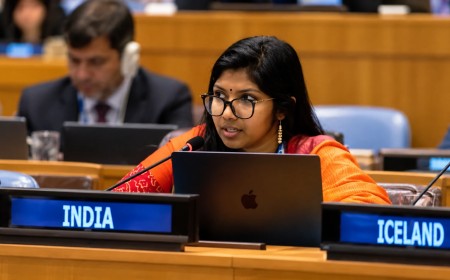
India has told the United Nations that if the Security Council is expanded, every new permanent member must have the same veto power as the current five, warning that permanent members without a veto would be "second-class". India's Permanent Representative to the UN, Ambassador Parvathaneni Harish, made the remarks at the UN General Assembly's Intergovernmental Negotiations (IGN) on Security Council reform, ThePrint (PTI) and India TV reported.
"As long as the veto exists, it must be held by all permanent members of a reformed Council," Harish said, according to the reports.
Key points
- India says all permanent members of a reformed Security Council must have the veto, as long as it exists.
- A new category of permanent or long-term members without a veto would be "second-class" and would not change the power of the current five, India said.
- India wants the veto used with "great restraint", especially on international peace and security.
- It called for a comprehensive reform package covering membership, regional representation, size, working methods and the veto together.
- India also criticised the IGN process for producing no outcome after 17 cycles.
What India said
Harish spoke at the IGN plenary on the "cluster debate on the question of the veto", ThePrint reported. His main points:
- Equal rights for new members: "As long as the veto exists, it must be held by all permanent members of a reformed Council."
- No second-class seats: A category of long-term members without the veto would be "second-class" and would not change the decision-making dynamic of the current permanent five (P5).
- Elections and permanence don't mix: Periodic elections and permanency are "fundamentally contradictory", he said, rejecting models that offer renewable long-term seats instead of permanent ones.
- Restraint: The veto should be used with "great restraint", particularly on questions of international peace and security.
- One package: Limiting the veto cannot be separated from other reform issues, including the categories of membership, regional representation, the size of the Council and its working methods.
A "de facto veto" in working methods
India also pointed to a less visible problem. Harish said any member of the Council can exercise an "effective or de facto veto" over presidential statements, press statements and sanctions committee decisions, because these work by consensus, ThePrint reported. He described the consensus rule in the IGN process itself as a "disguised, de facto veto".
"Seventeen cycles later, we have no outcome to show for it," he said, calling for text-based negotiations with clear timelines and milestones. Reform limited only to non-permanent seats would border on "failure", he added.
The Security Council today
| Feature | Current position |
|---|---|
| Members | 15 |
| Permanent members with veto (P5) | China, France, Russia, the United Kingdom and the United States |
| Non-permanent members | 10, elected for two-year terms |
| Last expansion | 1965, when non-permanent seats went from 6 to 10 |
| India's last term | 2021 to 2022, as a non-permanent member |
| India's next bid | A non-permanent seat for 2028 to 2029; the election is in June 2027, against Tajikistan for the single Asia-Pacific seat |
Source: ThePrint (PTI) and UN records.
Harish noted that the 1965 expansion changed the ratio of permanent to elected members from 5:6 to 5:10, which, he argued, strengthened the P5 rather than weakening them.
India's long campaign for a permanent seat
India has sought a permanent seat for decades, arguing that the Council, designed in 1945, does not reflect today's world. Its case rests on its population, the world's largest; its economy, among the five largest; its long record as one of the biggest contributors of troops to UN peacekeeping; and its role as a voice for the Global South.
India works with Brazil, Germany and Japan in the G4 group, which supports one another's bids for permanent seats. A rival group of countries, known as Uniting for Consensus, which includes Pakistan and Italy, opposes new permanent seats and backs more elected members instead. African countries, under a common position, seek two permanent seats with the veto and more non-permanent seats for Africa.
Four of the five permanent members, France, the UK, the US and Russia, have at various times said they support India's bid. China has not endorsed it.
Why the veto question is so hard
The veto is the most contested part of the reform debate:
- The P5 are reluctant to share the power they hold, and any change to the UN Charter needs the approval of two-thirds of the General Assembly and all five permanent members.
- Some countries want to curb the veto rather than extend it, arguing it has paralysed the Council on conflicts such as Syria, Ukraine and Gaza.
- The G4 has in the past said new permanent members could agree not to use the veto for a period after joining, as a compromise. India's latest statement makes clear that, in principle, it rejects a permanent second tier.
How the reform talks have moved, or not
Talks on Security Council reform have gone on for decades:
- 1965: The only expansion so far, raising the Council from 11 to 15 members, all of the new seats non-permanent.
- 1993: The General Assembly set up a working group to study reform, which met for years without agreement.
- 2005: At the UN World Summit, the G4 put forward a draft to add six permanent and four non-permanent seats, suggesting that new permanent members would not use the veto until a review. It was never put to a vote.
- 2009: The current Intergovernmental Negotiations began in the General Assembly.
- Since then: The IGN has met every year, but without an agreed negotiating text, which is what India means by "seventeen cycles later, we have no outcome".
India's call for text-based negotiations with timelines is aimed at turning the annual debate into a real negotiation. Many developing countries back the idea, while some members of the Uniting for Consensus group oppose moving to a text that might lock in new permanent seats.
What India wants from reform
- More permanent and non-permanent seats, with fair representation for Asia, Africa and Latin America.
- Equal rights for new permanent members, including the veto as long as it exists.
- Restraint in using the veto, especially in crises involving mass atrocities and threats to peace.
- Better working methods, including more transparency and an end to consensus rules that act as a hidden veto.
- A clear timetable for negotiations, rather than open-ended debate.
Why it matters
For India, a permanent seat would mean a say in every major decision on war, peace and sanctions, from which it is often excluded today. The reform talks have dragged on for years without a negotiating text, and India's tougher language reflects frustration with the pace. With India also contesting the 2028 to 2029 non-permanent seat, its diplomats are likely to keep pressing the issue at the UN in the months ahead.
India's message was blunt: a bigger Council with a two-tier permanent membership is no reform at all.
Frequently asked questions
What's Your Reaction?
 Like
0
 Dislike
0
 Love
0
 Funny
0
 Wow
0
 Sad
0
 Angry
0




Comments (0)