


How ISRO launches work, from Sriharikota to orbit
ISRO launches from Sriharikota on four rocket families: PSLV, GSLV, LVM3 and SSLV. How a launch works, the orbits it reaches and what went wrong in 2025-26.

New Delhi (Desk), 18 Oct 2026 (IST) · Explainer
India is one of a handful of countries that can launch its own satellites, and send probes to the Moon and Mars, on rockets it builds itself. Almost every Indian launch lifts off from one place: the Satish Dhawan Space Centre at Sriharikota, an island on the Andhra Pradesh coast about 80 km north of Chennai.
This explainer covers how an ISRO launch works, the rockets it uses, and why 2025 and early 2026 were difficult years for its most reliable workhorse.
Key points
- ISRO's main rockets: PSLV, GSLV, LVM3 and the small SSLV.
- Launches take place from two pads at Sriharikota; a new spaceport for small rockets is being built at Kulasekarapattinam in Tamil Nadu.
- East-facing launches use the Earth's spin; polar launches head south over the Bay of Bengal.
- PSLV failed on its May 2025 mission and again in January 2026 (PSLV-C62), its first back-to-back failures.
- LVM3, the rocket chosen for the Gaganyaan human spaceflight programme, had a clean record after nine flights, as of early 2026.
Why Sriharikota?
The site was chosen in the late 1960s for three reasons. It sits on the east coast, so rockets launched eastward fly out over the sea, away from towns. It is fairly close to the equator, which gives eastward launches a boost from the Earth's rotation. And it allows southward launches over the Bay of Bengal into polar orbits without crossing other countries' land soon after lift-off.
Sriharikota has two launch pads in use. A second spaceport at Kulasekarapattinam, near Thoothukudi in Tamil Nadu, is being built for small launches; its location lets rockets fly straight south into polar orbit without the curving path that launches from Sriharikota need to avoid Sri Lanka.
ISRO's rockets
| Rocket | Stages | Typical job | Approximate capacity |
|---|---|---|---|
| PSLV | 4 (solid and liquid) | Earth observation and small satellites to polar orbits | About 1,750 kg to sun-synchronous orbit |
| GSLV (Mk II) | 3, with an Indian cryogenic upper stage | Communication and positioning satellites | About 2,000 to 2,500 kg to geosynchronous transfer orbit |
| LVM3 | 3, with two large solid boosters | Heavy satellites, Chandrayaan, Gaganyaan | About 4,000 kg to geosynchronous transfer orbit |
| SSLV | 3 solid plus a small liquid stage | Small satellites, quick turnaround | Up to about 500 kg to low Earth orbit |
The PSLV, first flown in 1993, became famous for launching Chandrayaan-1 (2008) and the Mars Orbiter Mission (2013), and for putting 104 satellites into orbit on a single flight in 2017. LVM3 carried Chandrayaan-3 to the Moon in 2023 and has launched large batches of OneWeb internet satellites for a commercial customer.
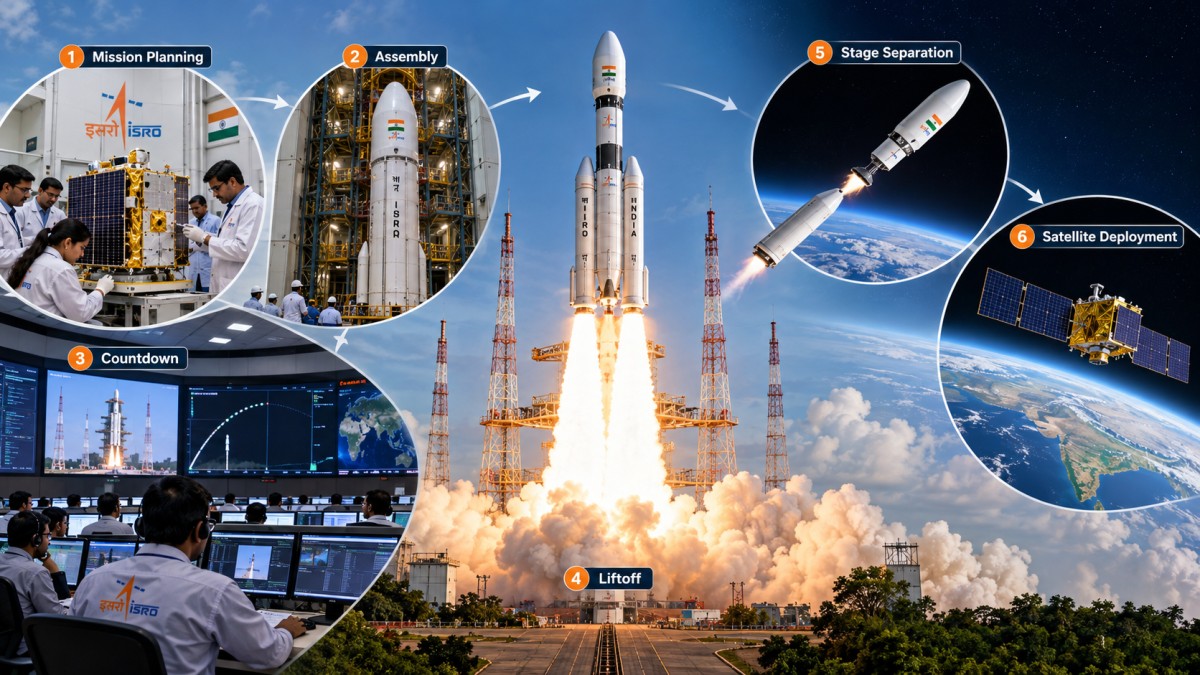
How an ISRO launch works, step by step
- Assembly. Stages are stacked in an assembly building, and the satellite is fitted inside the nose cone, called the payload fairing.
- Move to the pad. The rocket is moved to the launch pad on a mobile platform.
- Countdown. A countdown of around a day checks every system, fills the liquid stages with propellant and arms the safety systems. The last minutes are run by an automatic launch sequence.
- Lift-off and staging. Each stage burns, then separates. The fairing separates once the rocket is above most of the atmosphere.
- Satellite separation. The final stage releases the satellite into its planned orbit, usually 15 to 20 minutes after lift-off for a PSLV flight.
- Tracking. Ground stations, including ISRO's network and stations abroad, track the rocket and then take over control of the satellite.
Where satellites go
- Low Earth orbit (a few hundred km up): Earth observation and the Gaganyaan crew module.
- Sun-synchronous orbit, a polar orbit that passes over each place at the same local time, which suits imaging satellites.
- Geosynchronous transfer orbit, an oval orbit from which a satellite uses its own engine to reach a fixed point about 36,000 km above the equator, where communication and weather satellites sit.
The PSLV setbacks of 2025 and 2026
The PSLV had flown dozens of missions with only rare failures. Then two failed in a row. PSLV-C61 failed in May 2025 and lost an Earth observation satellite. PSLV-C62, launched on 12 January 2026 as its return to flight, also failed to reach orbit. ISRO Chairman V. Narayanan said the third stage produced less thrust than needed because of an unexpected drop in chamber pressure, Business Standard reported.
A failure analysis committee submitted its report in June 2026. The government said the cause had been found but did not publish the report, according to reports. ISRO sources said in August that launches were expected to resume within about two months, Kerala Kaumudi reported.
Why it matters: Satellites launched by ISRO provide India's weather forecasts, disaster warnings, satellite positioning through NavIC, television and border surveillance. A reliable launcher lets India put up these satellites on its own schedule, and earns money from foreign customers. The PSLV failures show how hard that reliability is to keep, at a time when private Indian launch companies are also entering the market.
What's next
ISRO's priorities include the uncrewed Gaganyaan test flights on LVM3, ahead of India's first human spaceflight; more positioning and communication satellites; and handing over more PSLV production to industry. Private companies such as Skyroot Aerospace and Agnikul Cosmos are developing their own small rockets, with launches from Sriharikota.
Why launches get delayed
Launch dates move often, and usually for good reasons:
- Weather: lightning, strong upper-level winds or heavy rain over Sriharikota can stop a launch, especially during the northeast monsoon from October to December.
- Technical holds: any sensor reading outside its limits can stop the automatic sequence, sometimes seconds before lift-off.
- Collision checks: ISRO checks that the rocket's path and the satellite's orbit don't come too close to other objects in space, and may shift the launch by minutes.
- Launch windows: some missions, such as those to the Moon or to a specific orbital slot, can only go at certain times.
How to watch a launch
ISRO runs a Launch View Gallery at Sriharikota where members of the public can watch launches from a safe distance. Registration opens on ISRO's website shortly before each launch, and places fill quickly. Most launches are also streamed live on ISRO's website and YouTube channel, usually starting about 30 minutes before lift-off.
Gaganyaan in brief
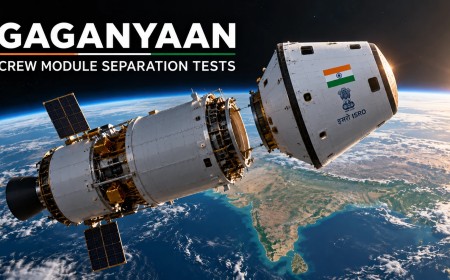
Gaganyaan is India's programme to send astronauts into low Earth orbit on an Indian rocket. Four Indian Air Force test pilots were named as astronaut-designates in 2024. Before any crew flies, ISRO plans uncrewed test flights, including one carrying a humanoid robot called Vyommitra, to test the crew module, life support and recovery at sea.
ISRO milestones at a glance
- 1975: Aryabhata, India's first satellite, launched on a Soviet rocket.
- 1980: the SLV-3 rocket put the Rohini satellite into orbit, India's first launch on its own rocket.
- 2008: Chandrayaan-1 went into orbit around the Moon and helped find signs of water.
- 2014: the Mars Orbiter Mission, launched in 2013, reached Mars on India's first attempt.
- 2023: Chandrayaan-3 landed near the Moon's south pole on 23 August, and Aditya-L1, India's first solar observatory, was launched.
Every launch from Sriharikota is a test of thousands of parts working in the right order within minutes. India has passed that test many times. Getting the PSLV back to its old record is the next one.
Frequently asked questions
What's Your Reaction?
 Like
0
 Dislike
0
 Love
0
 Funny
0
 Wow
0
 Sad
0
 Angry
0





Comments (0)