


Gaganyaan clears crew module separation tests, what's next
ISRO has completed ground tests of how Gaganyaan's crew capsule separates from its service module, a key step before the uncrewed G1 flight planned for 2026.

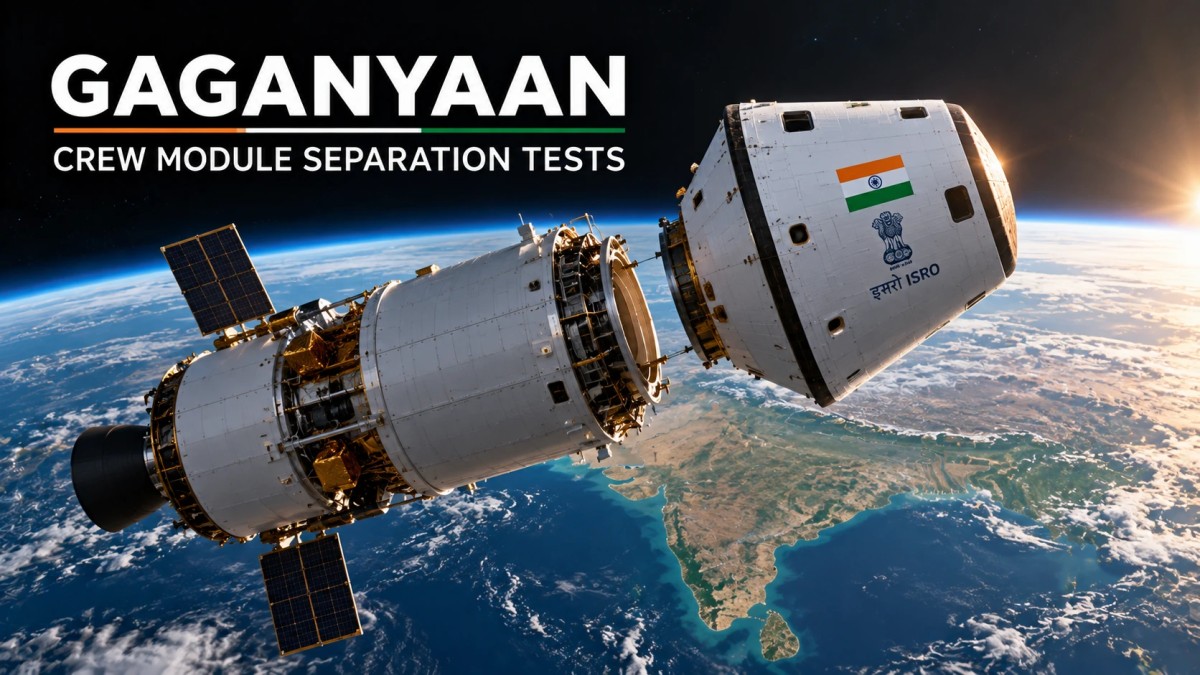
India's human spaceflight programme has passed another ground test. The Indian Space Research Organisation (ISRO) said on 16 October 2026 that it has completed a series of tests on how the Gaganyaan crew capsule separates from the service module that carries it through orbit, a step that has to work perfectly before astronauts can come home.
The tests, at the Vikram Sarabhai Space Centre (VSSC) in Thiruvananthapuram, Kerala, were done ahead of G1, the first uncrewed Gaganyaan flight, which ISRO is targeting for 2026.
Key points
- ISRO announced on 16 October that Crew Module–Service Module separation tests for Gaganyaan were complete.
- A full-scale test setup simulated the separation, including the cutting of umbilical lines that carry power and fluids between the two modules.
- ISRO says the capsule's electronics, heat shield and other key systems withstood the separation shocks.
- The uncrewed G1 flight, carrying the half-humanoid robot Vyommitra, is targeted for 2026; the first crewed flight for 2027.
What ISRO tested at Thiruvananthapuram
ISRO built a test setup that simulated the full Crew Module–Service Module assembly, fitted with extensive instruments. It then ran the separation sequence. The aim, in ISRO's words, was to "validate the overall design adequacy of the separation system".
Separation isn't a single event. It's a chain of precisely timed steps using pyrotechnic devices, small explosive charges that cut connections on command, and jettisoning systems that push the two modules apart. Several umbilical connections, which carry electrical and fluid services from the service module to the crew capsule, have to be cut cleanly along the way.
ISRO said the tests showed that key systems survive the shock. That list includes the capsule's avionics, its inertial systems (which track position and orientation), the thermal protection system on the aft and conical heat shields, the deployable shield that protects the umbilical area, and the pyrotechnic devices of two other systems: the uprighting system and the thermal and humidity control system.
The agency didn't publish the number of tests or any measurements.
Why the separation step matters for astronauts
Gaganyaan's spacecraft has two parts. The service module carries the engines, fuel and power systems that keep the spacecraft working in orbit. The crew module is the capsule where astronauts sit, and the only part built to survive the heat of returning through Earth's atmosphere.
Before re-entry, the two must separate. If they don't, or if the break damages the capsule, the heat shield can fail. It's one of the most unforgiving moments of any crewed mission, which is why ISRO is testing it on the ground before trying it in space.
Think of it as testing whether the lifeboat can be released from the ship without cracking its own hull.
The umbilical lines make it harder. While docked together, the two modules share power, data and fluids through these connections. Cutting them has to happen in the right order, without sparks, leaks or debris that could damage the capsule just before it meets the atmosphere.
Gaganyaan separation test: one of a series in 2026
This test follows several others this year. In July, ISRO said it had completed three qualification tests on crew module systems: the uprighting system, which inflates floats so the capsule sits upright after splashdown; the umbilical disconnection on the crew module side; and the structural loads on the apex cover, which engineers tested at about 1.75 times the expected loads, All India Radio reported.
Earlier in 2026, a crew module was dropped from an aircraft to prove its parachute descent, according to The Week. Since then, the G1 capsule has been fully integrated with its propulsion and control systems.
The biggest flight test so far came in October 2023, when ISRO flew TV-D1, a test vehicle that checked the crew escape system: the rockets that would pull the capsule away from a failing launcher. The capsule was then recovered from the Bay of Bengal.
Each test removes a risk. None of them alone sets a launch date.
Why it matters: For India, Gaganyaan is the step that would make it only the fourth country, after the Soviet Union (now Russia), the United States and China, to send people into orbit on its own rocket. For readers abroad, it's a sign that India's space programme, known for low-cost Moon and Mars missions, is moving into the most demanding area of spaceflight, and taking the slow, test-heavy route to get there.
What comes next: the uncrewed G1 flight
G1 will be the first full flight test of the Gaganyaan spacecraft in orbit. It won't carry people. Instead it will carry Vyommitra, a half-humanoid robot designed to sit in the crew seat and report on conditions inside the capsule. ISRO first showed Vyommitra to the public in January 2020.
The point of G1 is to fly the whole mission end to end without risking anyone: launch, orbit, the separation tested this month, re-entry, parachutes and splashdown, followed by recovery at sea. Data from the flight will feed into the design reviews before ISRO clears the spacecraft for people.
ISRO Chairman V. Narayanan said in June 2026 that G1 was expected in the last quarter of the year, and repeated in September that it would fly within 2026, The Week reported. No date has been announced. The flight is planned on the human-rated version of the LVM3 rocket from the Satish Dhawan Space Centre at Sriharikota, Andhra Pradesh.
G1 has already slipped more than once. The original plan, years ago, was December 2020; a later target was December 2025. ISRO has described its approach as cautious and step by step, with long ground testing and uncrewed flights before any crew flies.
After G1, ISRO plans more uncrewed flights before the first crewed mission, targeted for 2027. That mission aims to take a crew to a low Earth orbit of about 400 km for a short stay and bring them back to a splashdown in Indian waters.
The people waiting for the ride
India named four astronaut-designates for Gaganyaan in February 2024, all Indian Air Force test pilots: Group Captains Prasanth Balakrishnan Nair, Ajit Krishnan and Angad Pratap, and Shubhanshu Shukla. Shukla has since flown to the International Space Station on the private Axiom Mission 4 in 2025, the first Indian to visit the station.
Prime Minister Narendra Modi first announced the programme in his Independence Day speech on 15 August 2018, with a target of a crewed flight by 2022. That date, like G1's, moved as the engineering work, and the pandemic, took longer than planned.
Beyond Gaganyaan, the government has set longer goals: an Indian space station, the Bharatiya Antariksh Station, by 2035, and an Indian on the Moon by 2040. In September 2024, the Cabinet raised total funding for the Gaganyaan programme to ₹20,193 crore (about $2.1 billion) to include the first space station module.
Ground tests rarely make headlines, and this one won't either. But spaceflight history is full of missions that failed at a moment just like this one, quietly, after a launch that looked perfect. ISRO's choice to rehearse the break-up of its own spacecraft, again and again, before risking a crew is the least glamorous part of the programme, and probably the most important.
Frequently asked questions
What's Your Reaction?
 Like
0
 Dislike
0
 Love
0
 Funny
0
 Wow
0
 Sad
0
 Angry
0



Comments (0)