


Ramayana Part 1 releases 5 Nov worldwide, including IMAX
Ramayana Part 1, starring Ranbir Kapoor, Sai Pallavi and Yash, opens worldwide on 5 Nov 2026 in IMAX. Release date, languages, cast and how to watch abroad.

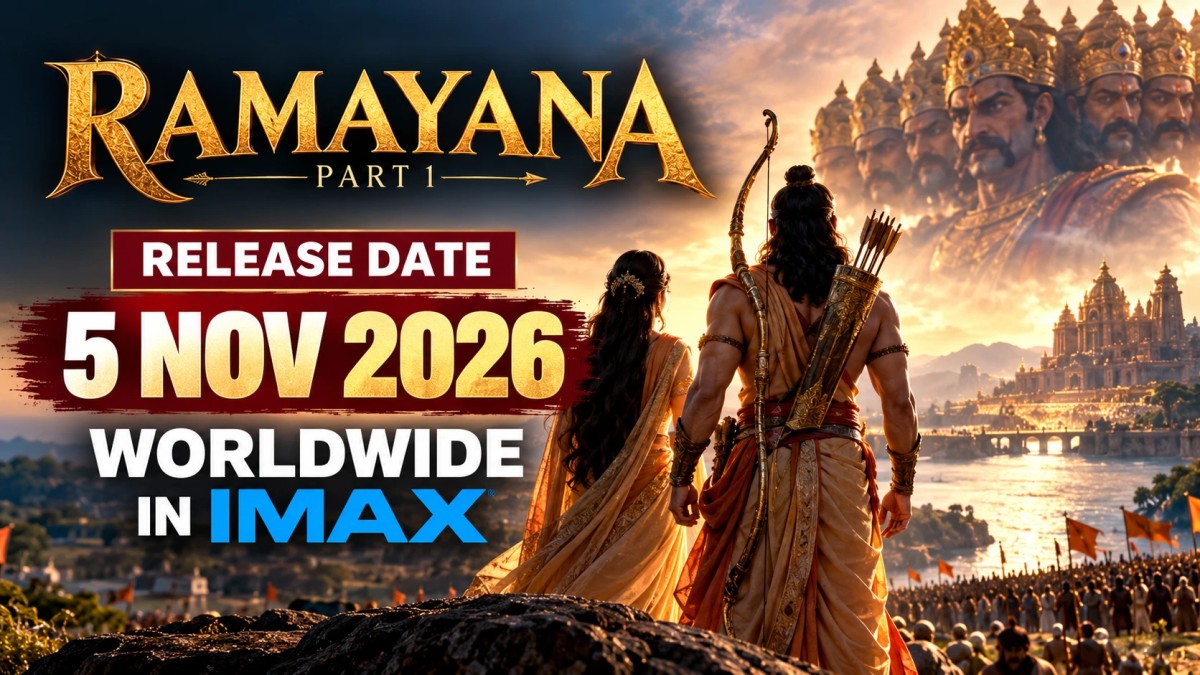
The first film in Nitesh Tiwari's two-part Ramayana will open in cinemas worldwide on Thursday, 5 November 2026, three days before Diwali. The makers have settled on that date after weeks of mixed signals between 5 and 6 November, and the film's international campaign is now under way.
Ranbir Kapoor plays Ram, Sai Pallavi plays Sita and Yash plays Raavan. Sony Pictures is handling the release outside India, which is unusual for an Indian film of this kind.
Key points
- Ramayana Part 1, officially titled Ramayana: Rise of a Legend, opens worldwide on 5 November 2026; Part 2 is set for Diwali 2027.
- It will release in Hindi, Tamil, Telugu, Kannada and Malayalam, and in IMAX and other premium formats, with an English version reported for IMAX screens.
- Sony Pictures distributes outside India; Dharma Productions handles the Hindi-speaking market in India.
- The international trailer was launched in Bengaluru on 15 October; advance bookings are reported to open on Dussehra.
Ramayana release date: why 5 November
The film had been linked to 6 November after an international trailer pointed to that date. The makers have since locked 5 November, a Thursday, which gives the film an extended run into the Diwali weekend. Diwali falls on Sunday, 8 November this year.
A Thursday opening is a common move for big Indian releases around festivals: it adds a day of collections before the weekend and catches audiences who take extra leave around the holiday.
The timing has a second, more obvious logic. In much of north India, Diwali marks Ram's return to Ayodhya after 14 years in exile, the very story this film tells. Releasing Ramayana in Diwali week puts it in cinemas at the one time of year when the epic is already on almost every Indian family's mind, in India and abroad.
Advance booking is reported to open on Dussehra, which is on 20 October in most of India. Some reports also mention paid previews on 4 November, though the makers haven't confirmed that.
Cast, crew and the scale of the project
Nitesh Tiwari, best known for Dangal (2016), one of the highest-grossing Indian films ever thanks partly to a huge run in China, directs. The film is produced by Namit Malhotra's Prime Focus Studios, in collaboration with the visual effects company DNEG and Yash's production house, Monster Mind Creations.
Alongside the three leads, Sunny Deol plays Hanuman, Ravi Dubey plays Lakshman, Arun Govil plays King Dashrath and Lara Dutta plays Kaikeyi, with Rakul Preet Singh as Shurpanakha. For many Indian viewers, Arun Govil's casting has its own resonance: he played Ram in Ramanand Sagar's television Ramayan, which ran on Doordarshan, the state broadcaster, in 1987–88 and became one of the most watched shows in Indian history. When Doordarshan re-ran it during the 2020 lockdown, the broadcaster said it again drew record audiences.
The leads bring very different fan bases. Ranbir Kapoor is one of Hindi cinema's biggest stars. Yash became a national name through the Kannada-language KGF films (2018 and 2022), which were hits well beyond Karnataka. Sai Pallavi built her following in Tamil, Telugu and Malayalam cinema. Casting across languages is part of the plan to make this a truly pan-Indian release.
Its title, Ramayana: Rise of a Legend, was announced on 28 September, Ranbir Kapoor's birthday, along with the release dates, The Hollywood Reporter India reported. The first full trailer came out on 30 July 2026 in five languages.
The makers haven't published a budget. Any figure you see quoted is an estimate.
The international push, and Sony's role
Sony Pictures is distributing the film outside India, while Dharma Productions releases it in the Hindi-speaking market at home. Sony announced the release details on X, according to The Hollywood Reporter India. In India, Dharma Productions, Karan Johar's company, brings long experience of releasing Hindi films across the country's big cinema chains.
That's the part that makes this release different. Big Indian films usually reach overseas audiences through specialist distributors who serve diaspora cinemas in the US, UK, Gulf and elsewhere. A Hollywood studio running the international release suggests the makers want audiences beyond the diaspora, the same ambition that saw RRR travel widely in 2022.
The international campaign opened with a trailer launch in Bengaluru on 15 October, hosted by Prime Focus Studios and Monster Mind Creations. Ranbir Kapoor, Yash, Sai Pallavi, Ravi Dubey, Rakul Preet Singh and director Nitesh Tiwari attended, ANI reported, and Ranbir Kapoor won over the local crowd by speaking partly in Kannada. The new trailer has an English version for international audiences, with additional dialogue in the Hindi version.
Why it matters: The Ramayana is one of the two great Sanskrit epics, the story of Prince Ram, his exile, the abduction of his wife Sita by the demon king Raavan, and her rescue. It's told and retold across South and Southeast Asia, from Indonesia's shadow puppets to Thailand's Ramakien. For readers abroad, this film is India's most ambitious attempt yet to put that story on global multiplex screens with Hollywood-level effects. For the Indian film industry, it's a test of whether a two-part mythological epic can work commercially worldwide.
Languages, IMAX and how to watch outside India
In India, the film releases in Hindi, Tamil, Telugu, Kannada and Malayalam. It will also play in IMAX and other premium large formats. The Hollywood Reporter India reported Hindi and English versions for IMAX, with the makers promoting it as an immersive 3D experience.
For viewers in the US, UK, Canada, Australia and the Gulf, the release runs through Sony Pictures' international network, so it should appear on mainstream cinema chains' booking pages rather than only at specialist screens. Local release dates can vary by a day because of time zones and country rules.
Diaspora families get a convenient calendar this year. Diwali falls on a Sunday this year, so many will be able to combine a cinema trip with festival plans that weekend. Expect high demand for evening shows in areas with large Indian communities, such as Leicester and Wembley in the UK, New Jersey and the San Francisco Bay Area in the US, Brampton in Canada and Dubai in the UAE. Booking early, once tickets open, is the sensible move.
Subtitles matter too. For non-Indian viewers, most international screenings of Indian films carry English subtitles, but check the listing, especially for the language versions.
Part 2 and the Diwali 2027 plan
The second part is set for Diwali 2027. Making two films back to back is a bet that audiences who see the first will return a year later, a strategy that worked for Baahubali (2015 and 2017).
It also raises the stakes for Part 1. A weak opening would hang over the second film for a year. A strong one would give the makers a ready-made audience for Diwali 2027.
Recent history shows the risk. Adipurush (2023), another big-budget telling of the same epic, drew heavy criticism over its dialogue and visual effects, and its makers changed some lines after release. Audiences, in other words, care a great deal about how this particular story is handled. Tiwari's team has kept unusually tight control of what's been shown so far, releasing one full trailer in July and holding the rest back for the international campaign.
There's a reason producers keep returning to this story. Almost every Indian viewer already knows how it ends, so the film can't sell surprise. It has to sell the telling. On 5 November, audiences in Mumbai and Manchester will be judging the same thing: not what happens, but how well it's told.
Frequently asked questions
What's Your Reaction?
 Like
0
 Dislike
0
 Love
0
 Funny
0
 Wow
0
 Sad
0
 Angry
0





Comments (0)