


RBI clears Emirates NBD India branches merger into RBL Bank
The RBI has cleared the merger of Emirates NBD's Mumbai, Chennai and Gurugram branches into RBL Bank from 1 Dec 2026. What it means for bank customers.

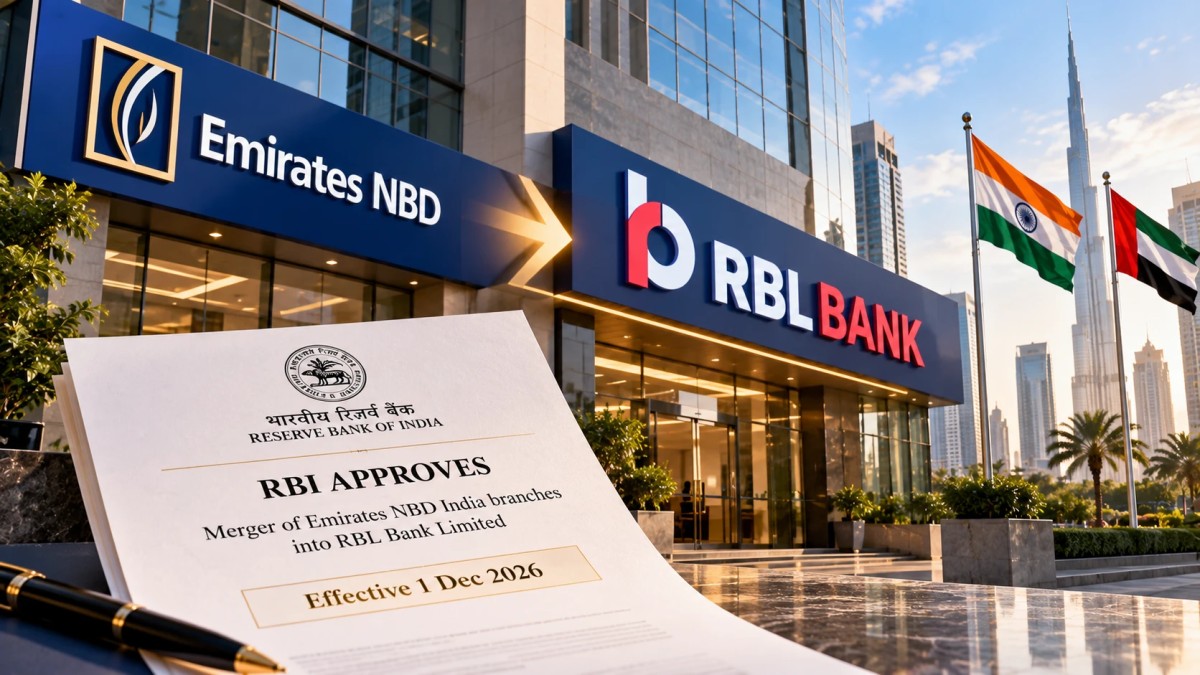
The Reserve Bank of India (RBI) has approved the merger of Emirates NBD's three Indian branches into RBL Bank, with effect from 1 December 2026. From that date, the Dubai lender's branches in Mumbai, Chennai and Gurugram will operate as RBL Bank branches.
Its notification is dated 16 October. It's the final step in a deal that has already made Emirates NBD the majority owner of RBL Bank, after a capital infusion of about $2.75 billion (around ₹26,000 crore) completed in June.
Key points
- The RBI sanctioned the amalgamation on 16 October 2026 under Section 44A(4) of the Banking Regulation Act, 1949. It takes effect on 1 December 2026.
- Emirates NBD's branches in Mumbai, Chennai and Gurugram become part of RBL Bank's network.
- Emirates NBD completed its majority stake purchase on 18 June 2026 and holds about 60% of RBL's expanded share capital.
- The two banks describe the deal as the largest foreign direct investment in Indian banking.
- This article is news, not investment advice.
What the RBI approved on 16 October
Under the sanctioned scheme of amalgamation, the Indian business of Emirates NBD Bank (P.J.S.C.) moves into RBL Bank Ltd. In the language of the scheme, Emirates NBD's India branches are the "transferor" and RBL Bank is the "transferee".
Section 44A of the Banking Regulation Act is the provision that governs voluntary mergers between banks in India. It needs shareholder approval and the RBI's sanction. Once sanctioned, the assets and liabilities of the transferring bank move to the bank that takes it over on the effective date.
The Competition Commission of India had already cleared the overall combination on 20 January 2026, including the branch merger on a going-concern basis, which means the business moves across as a running operation rather than being wound up.
RBL Bank Emirates NBD merger: how the deal was built
This didn't happen overnight. The two banks announced the transaction in October 2025, when Emirates NBD agreed to invest about $3 billion in fresh RBL shares for a controlling stake. Reports at the time put the figure at about ₹26,850 crore.
Approvals came in stages. The UAE's central bank, India's competition regulator, the RBI and the market regulator SEBI (the Securities and Exchange Board of India) all had to sign off. RBL said on 15 May 2026 that it had received the required regulatory and government approvals, and Emirates NBD completed the share purchase on 18 June, Business Today reported.
The branch merger was always the second stage. The two banks said when they agreed the deal that RBI guidelines required Emirates NBD's India branches to be amalgamated into RBL once the share issue was done, so the Dubai bank wouldn't run a separate Indian operation alongside the one it now controls.
Why the deal is a first for Indian banking
Both banks have called it the largest foreign direct investment in India's banking sector and the biggest equity fundraise by an Indian bank. Gulf News reported that it's also the first time a profitable Indian private lender will be majority-owned by a foreign bank.
Indian law allows foreign investors to own up to 74% of a private bank, but voting rights for any single shareholder are capped at 26% under the Banking Regulation Act. That's why reports in April 2026 described the RBI as allowing Emirates NBD up to 74% ownership with voting rights capped at 26%.
Emirates NBD is Dubai's largest bank and is majority-owned by the Investment Corporation of Dubai, the emirate's government investment arm. RBL Bank traces its roots to Ratnakar Bank, founded in Kolhapur, Maharashtra, in 1943. After the merger, the combined Indian network is expected to have more than 560 branches and about 15 million customers, Gulf News reported when the deal was announced.
When the deal was announced in October 2025, Emirates NBD Group CEO Shayne Nelson said the investment reflected faith in India's "vibrant and expanding economy". RBL Bank's CEO R. Subramaniakumar called it "a milestone" that gave the bank a strong anchor shareholder.
What it means for customers of the three branches
If you bank with Emirates NBD in Mumbai, Chennai or Gurugram, you'll become an RBL Bank customer on 1 December. Your deposits and loans move to RBL under the scheme.
Two things are worth checking. First, deposit insurance. In India, the Deposit Insurance and Credit Guarantee Corporation (DICGC) covers up to ₹5 lakh (about $5,150) per depositor per bank. If you hold accounts at both Emirates NBD India and RBL Bank, they'll count as one bank after the merger, so the ₹5 lakh cover applies to the combined amount, not to each separately.
Second, account terms. Merging banks usually tell customers in writing about changes to account numbers, cheque books, branch codes (IFSC) and fees. Watch for letters or emails from the bank before 1 December, and check RBL's website rather than relying on forwarded messages.
RBL Bank's own customers shouldn't see changes from the branch merger itself.
Why it matters: For India, this is a test of how far the RBI will let foreign banks own and run Indian lenders, and a sign that Gulf capital now sees Indian banking as a long-term bet, not just a market for remittances. For readers in the UAE and the wider Gulf, home to millions of Indians, it means a Dubai bank with a large Indian branch network, which could shape how money moves between the two.
The Gulf angle: capital, not just remittances
The UAE is one of India's biggest trading partners and home to one of the largest Indian communities abroad. For decades, the money flow has mostly gone one way: Indians in the Gulf sending earnings home.
This deal reverses part of that. A Gulf bank is putting billions of dollars of equity into an Indian lender. Gulf News linked it to deepening UAE–India economic ties, including the India–Middle East–Europe Economic Corridor announced in 2023, and to Emirates NBD's aim of serving Indian businesses across the region.
For RBL itself, the capital matters most. Gulf News reported when the deal was announced that the infusion would lift the bank's Tier-1 capital ratio, the core measure of a bank's financial cushion, and should lower its cost of funds. More capital means room to lend more without raising money again soon.
There's a fair question about what changes for ordinary RBL customers over time. A large, well-capitalised parent can lower a bank's cost of funds and support lending growth. It also means strategy is increasingly set in Dubai. How that plays out will show over years, not months.
What happens next
The next date to watch is 1 December, when the branch merger takes effect. Any changes to customer accounts should be communicated before then.
Beyond that, investors will follow RBL's quarterly results for signs of how the new capital is being used. This article doesn't offer any view on RBL Bank's shares.
The three branches themselves are small. What's significant is the signal: a Gulf bank now owns a mid-sized Indian lender outright, and the RBI has let it happen. Other foreign banks will be watching how the first one goes.
This article is for information only and is not investment advice.
Frequently asked questions
What's Your Reaction?
 Like
0
 Dislike
0
 Love
0
 Funny
0
 Wow
0
 Sad
0
 Angry
0







Comments (0)