


India's states and union territories explained
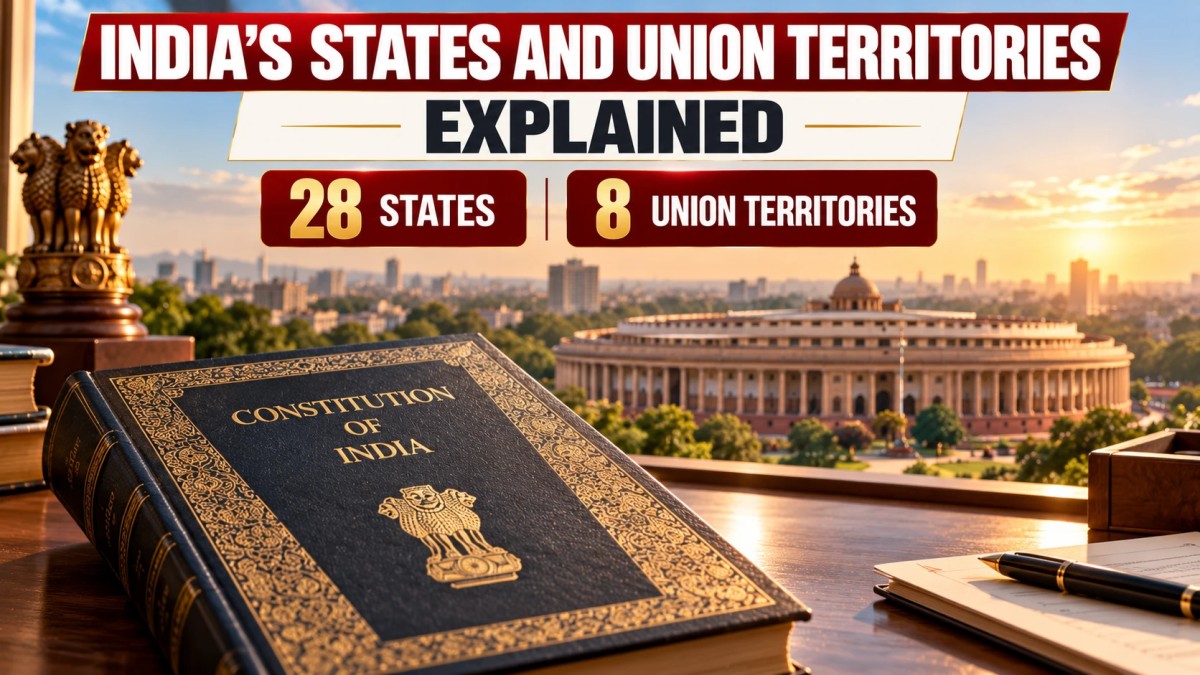
India has 28 states and 8 union territories. What separates a state from a UT, why Delhi and Jammu and Kashmir are special, and how new states are created.

New Delhi (Desk), 18 Oct 2026 (IST) · Explainer
India is a union of states. As of 2026, it is divided into 28 states and 8 union territories (UTs). States elect their own governments and share power with the Centre; most union territories are run more directly by the central government.
The map has changed many times since 1947, and it may change again. This guide explains the difference between a state and a UT, the special cases, and how new states are made.
Key points
- 28 states and 8 union territories, a count unchanged since January 2020.
- States have elected governments and their own powers under the Constitution's State List.
- Union territories are administered by the President through an administrator; Delhi, Puducherry and Jammu and Kashmir also have elected assemblies.
- Parliament can create, merge or rename states under Article 3 of the Constitution.
- Jammu and Kashmir became a UT in 2019; its assembly passed a resolution seeking statehood in September 2026.
India's states and union territories
The 28 states: Andhra Pradesh, Arunachal Pradesh, Assam, Bihar, Chhattisgarh, Goa, Gujarat, Haryana, Himachal Pradesh, Jharkhand, Karnataka, Kerala, Madhya Pradesh, Maharashtra, Manipur, Meghalaya, Mizoram, Nagaland, Odisha, Punjab, Rajasthan, Sikkim, Tamil Nadu, Telangana, Tripura, Uttar Pradesh, Uttarakhand and West Bengal.
The 8 union territories: Andaman and Nicobar Islands; Chandigarh; Dadra and Nagar Haveli and Daman and Diu; Delhi (the National Capital Territory); Jammu and Kashmir; Ladakh; Lakshadweep; and Puducherry.
Uttar Pradesh is the largest state by population, Rajasthan by area. Goa is the smallest state by area, and Sikkim the smallest by population.
State vs union territory: the difference
| State | Union territory | |
|---|---|---|
| Government | Elected assembly and Chief Minister | Administrator appointed by the President; some have assemblies |
| Head | Governor (appointed by the President) | Lieutenant Governor or Administrator |
| Powers | Laws on the State List (police, public order, health, agriculture) | Parliament can make laws on all subjects |
| Police | State government | Usually the Union Home Ministry |
| Rajya Sabha seats | Yes | Only UTs with assemblies |
States get their powers from the Seventh Schedule of the Constitution, which splits subjects into a Union List, a State List and a Concurrent List. Within the State List, a state government decides policy. Union territories have no such guaranteed area; Parliament and the Centre have the last word.
The special cases
Delhi: The National Capital Territory has an elected assembly and a Chief Minister, under Article 239AA. But police, public order and land are controlled by the Centre through the Lieutenant Governor. Control over Delhi's civil servants has been the subject of long court battles and a 2023 law that gave the Centre a greater say.
Puducherry: has an elected assembly and a Chief Minister, with a Lieutenant Governor.
Jammu and Kashmir: Until August 2019, it was a state with special status under Article 370. Parliament then removed that status and split it into two UTs: Jammu and Kashmir, with an assembly, and Ladakh, without one. The Supreme Court upheld the change in December 2023 and asked for statehood to be restored "at the earliest". Assembly elections were held in 2024. The J&K Assembly passed a resolution seeking full statehood on 28 September 2026, according to reports; the Centre has said statehood will be restored at an appropriate time.
Ladakh: groups in Ladakh have campaigned for statehood or for protection under the Sixth Schedule, which gives tribal areas their own councils.
How new states are made
Under Article 3, Parliament can form a new state, change a state's borders or rename it by an ordinary law. The President must first refer the bill to the state concerned for its views, but Parliament doesn't have to accept them.
Major changes since independence:
- 1956: The States Reorganisation Act redrew the map largely along language lines.
- 1960: Bombay State was split into Maharashtra and Gujarat.
- 1966: Haryana was carved out of Punjab.
- 1971 to 1987: Several Northeastern states and Goa became full states; Sikkim joined India as a state in 1975.
- 2000: Chhattisgarh, Uttarakhand and Jharkhand were formed.
- 2014: Telangana was formed from Andhra Pradesh.
- 2019: Jammu and Kashmir became two union territories.
- 2020: Dadra and Nagar Haveli and Daman and Diu were merged into one UT.
Why it matters: Whether a place is a state or a UT decides who runs its police, who sets its policies and how much say its voters have. Debates over statehood, from Jammu and Kashmir and Ladakh to demands for new states such as Vidarbha or Gorkhaland, are really debates about power and identity. For readers abroad, India's structure is closer to a federation like the US or Canada than to a centralised state, but with a stronger Centre.
Shared capitals
- Chandigarh is the shared capital of Punjab and Haryana, and a UT in its own right.
- Hyderabad was the shared capital of Andhra Pradesh and Telangana for up to ten years after 2014; that period ended in June 2024.
How a state is governed
Each state has a Governor, appointed by the President, who is the formal head; a Chief Minister and council of ministers, who hold real power; and an elected legislative assembly. Six states also have a second house, a legislative council: Andhra Pradesh, Bihar, Karnataka, Maharashtra, Telangana and Uttar Pradesh.
Below the state, the 73rd and 74th Amendments of 1992 created a third tier of elected local government: panchayats in villages and municipalities in towns and cities. Elections to these bodies are run by state election commissions.
States are also represented in Parliament's upper house, the Rajya Sabha, where seats are shared out roughly by population. Uttar Pradesh has the most, with 31 members. Members are elected by each state's MLAs, so a state's ruling party usually wins most of its Rajya Sabha seats.
Why borders follow language
When India became independent, its provinces were inherited from British rule and from hundreds of princely states. Many groups demanded states for their languages. After protests, including those that followed the death of Potti Sriramulu during a fast for a Telugu-speaking state in 1952, the government set up the States Reorganisation Commission. Its report led to the 1956 Act, and language has shaped India's map ever since.
The smaller union territories
- Andaman and Nicobar Islands: a chain of islands in the Bay of Bengal, closer to Myanmar and Indonesia than to mainland India, and home to an important tri-service military command.
- Lakshadweep: India's smallest UT, a group of coral islands in the Arabian Sea off Kerala, where entry for visitors needs a permit.
- Dadra and Nagar Haveli and Daman and Diu: former Portuguese territories on the west coast, merged into one UT in 2020.
- Chandigarh: a planned city designed by the architect Le Corbusier, run directly by the Centre while serving as capital of two states.
- Ladakh: a high-altitude region bordering China and Pakistan, with elected hill development councils in Leh and Kargil but no assembly.
India's map has been redrawn more often than most countries'. Each change began as a demand from people who wanted more say over their own affairs, and the next one will too.
Frequently asked questions
What's Your Reaction?
 Like
0
 Dislike
0
 Love
0
 Funny
0
 Wow
0
 Sad
0
 Angry
0



Comments (0)