


Sensex vs Nifty explained, what India's indices measure
The Sensex tracks 30 BSE stocks and the Nifty 50 tracks 50 NSE stocks. How each is calculated, why they move together and what index funds do. Not advice.

New Delhi (Desk), 18 Oct 2026 (IST) · Explainer
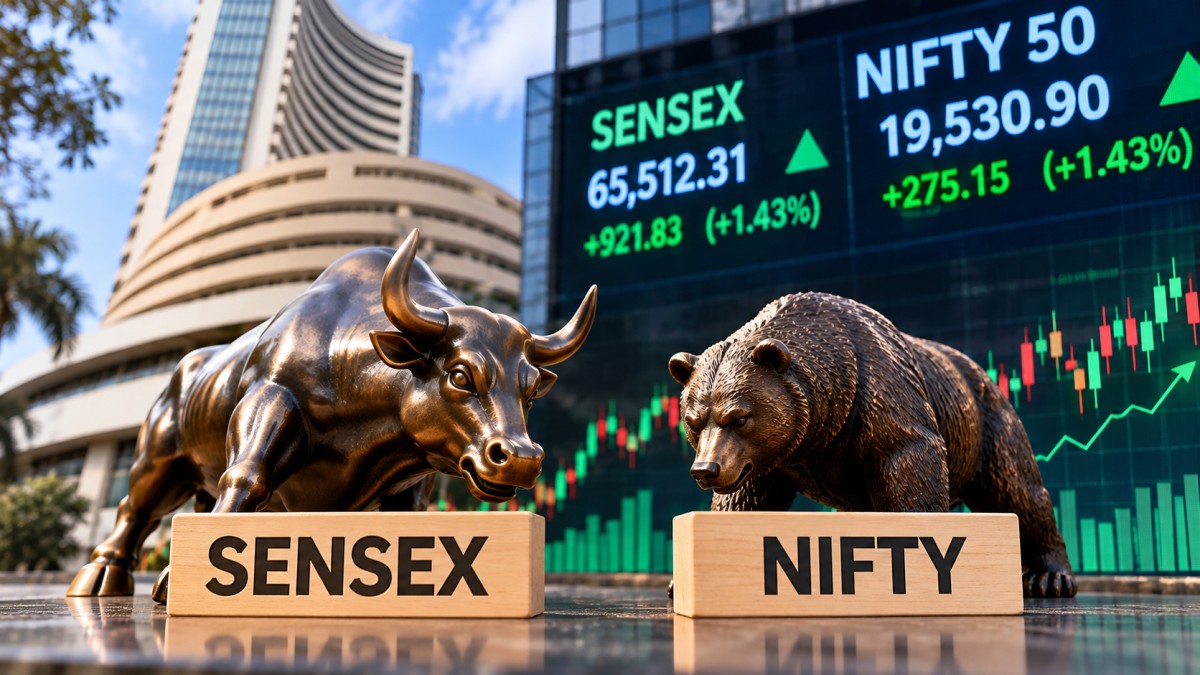
When news reports say "the market rose today", they usually mean one of two numbers: the Sensex or the Nifty 50. Both are stock market indices, scorecards that track the share prices of a basket of India's largest listed companies.
On Friday, 16 October 2026, the Sensex closed at 74,729.28 and the Nifty 50 at 23,146.15. Here's what those numbers mean, how the two indices differ, and why they almost always move together.
Key points
- The Sensex is run by BSE (Bombay Stock Exchange) and tracks 30 large companies.
- The Nifty 50 is run by NSE Indices, part of the National Stock Exchange, and tracks 50 companies.
- Both are weighted by free-float market capitalisation: bigger companies, and those with more shares freely traded, count for more.
- Because they hold many of the same large companies, they usually rise and fall by similar percentages.
- Index funds and ETFs let investors buy the whole basket. This article is general information, not investment advice.
Sensex vs Nifty: the basics
| Sensex | Nifty 50 | |
|---|---|---|
| Full name | S&P BSE Sensitive Index (now BSE Sensex) | Nifty 50 |
| Exchange | BSE, Mumbai | National Stock Exchange (NSE), Mumbai |
| Number of companies | 30 | 50 |
| Base | 1978-79 = 100 | 3 November 1995 = 1,000 |
| First published | 1986 | 1996 |
| Level on 16 Oct 2026 | 74,729.28 | 23,146.15 |
The Sensex is older; the Nifty's 50 stocks make it slightly broader. The different starting points are why their levels look so different: a Sensex of about 74,700 and a Nifty of about 23,100 don't mean one market is "bigger". What matters is the percentage change.
How the indices are calculated
Each company's weight in the index depends on its free-float market capitalisation: its share price multiplied by the number of shares available for public trading. Shares held by promoters, governments and other locked-in holders are left out.
So a company like Reliance Industries or HDFC Bank, with a very large market value, moves the index far more than a smaller member. When a few heavyweights rise sharply, the index can rise even if most stocks fall.
Both index committees review the list of companies regularly, usually twice a year, and replace companies that have shrunk or become less traded with newer, larger ones. That keeps each index a picture of India's biggest listed businesses rather than a fixed list.
Why they move together
Most of the Sensex's 30 companies are also in the Nifty 50, and the largest ones carry similar weights in both. So on most days, the Sensex and the Nifty rise or fall by roughly the same percentage. On 15 October 2026, for example, the Sensex rose 2.11% and the Nifty 1.66%, both led by IT stocks.
Small differences come from the extra 20 companies in the Nifty and from small differences in weights.
What else is an "index"?
The two headline indices are only part of the picture. Both exchanges publish dozens of others:
- Sector indices: Nifty IT, Nifty Bank, BSE Healthcare and others show how one industry is doing.
- Size indices: Nifty Midcap 150 and Nifty Smallcap 250, or BSE's equivalents, track smaller companies, which can behave very differently from the big ones.
- Broad indices: the Nifty 500 covers most of the market's value.
- Volatility: India VIX measures how much traders expect the Nifty to swing.
Why it matters: Millions of Indians now own shares through mutual funds and pension savings, and index funds that copy the Sensex or the Nifty are among the most popular. For NRIs and foreign investors, these indices are the quickest way to judge how Indian companies are doing and how foreign money is flowing. A headline "Sensex falls 1,000 points" can sound alarming, but at a level of about 74,000, that's a fall of about 1.3%.
Index funds and ETFs
An index fund or exchange-traded fund (ETF) buys all the companies in an index in the same proportions. Its returns follow the index, minus a small fee. Because nobody is picking stocks, the fees are usually lower than for actively managed funds.
For a beginner, the key points are:
- An index fund won't beat its index, by design; it aims to match it.
- Indices can fall sharply, and have done so many times. Past returns don't predict future ones.
- NRIs can invest in Indian funds through NRE or NRO accounts, subject to the fund house's rules for their country of residence.
How to read market news
- Points vs per cent: always look for the percentage. A 500-point move is much smaller at 74,000 than it was at 20,000.
- Closing vs intraday: headline figures are usually closing levels at 3:30 PM IST; intraday highs and lows can be very different.
- Record highs: a "record" only means the index is above its previous peak. It says nothing about where it will go next.
Sensex milestones
The Sensex has climbed from its base of 100 in 1978-79 through a string of milestones:
| Level | First reached |
|---|---|
| 1,000 | 1990 |
| 10,000 | 2006 |
| 20,000 | 2007 |
| 30,000 | 2015 |
| 50,000 | 2021 |
| 70,000 | 2023 |
| 80,000 | 2024 |
It touched about 85,000 in September 2024. At about 74,700 on 16 October 2026, it is below that peak, a reminder that indices fall as well as rise.
What moves the Sensex and Nifty
- Company results: quarterly earnings, especially from heavyweights in banking, IT and energy.
- Interest rates: RBI rate changes affect borrowing costs and company valuations. The RBI raised its policy rate to 5.50% on 7 October 2026.
- Foreign money: buying and selling by foreign portfolio investors can move the market sharply in either direction.
- Oil and the rupee: India imports most of its crude oil, so high prices and a weak rupee hurt many companies.
- Global markets: big moves in the US and Asia often carry over to Indian markets the next morning.
- Government policy: the Union Budget, tax changes on capital gains and big reforms can move the market on the day they are announced.
Sensex or Nifty: which should you follow?
For following the market, either works, because they usually move together. Business TV and newspapers quote both. The Nifty 50 is more widely used by professional investors, and it is the basis for India's most traded index futures and options, so many traders treat it as the main benchmark. The Sensex has the longer history and is often the headline number in general news.
If you invest in an index fund, the choice of index matters less than the fund's expense ratio (its annual fee) and tracking error (how closely it follows the index). Funds based on either index give broadly similar exposure to India's largest companies.
Trading hours and holidays
Indian stock markets trade from 9:15 AM to 3:30 PM IST, Monday to Friday, with a short pre-open session from 9:00 AM. They close on weekends and on the exchanges' list of trading holidays, which includes major festivals. On Diwali, the exchanges usually hold a short special evening session called Muhurat trading, a tradition marking the start of the Hindu financial year.
Two numbers can't tell you everything about an economy of 140 crore people. But read correctly, as percentages and over time, they are a fair daily summary of how India's largest companies are valued.
This article is general information, not investment advice.
Frequently asked questions
What's Your Reaction?
 Like
0
 Dislike
0
 Love
0
 Funny
0
 Wow
0
 Sad
0
 Angry
0





Comments (0)