


How the IPL auction works, purse, RTM and mini-auction rules
How the IPL auction works: retentions, purse and salary cap, base prices, RTM cards and the overseas fee cap. Plus what is reported for the 2027 mini-auction.

New Delhi (Desk), 18 Oct 2026 (IST) · Explainer
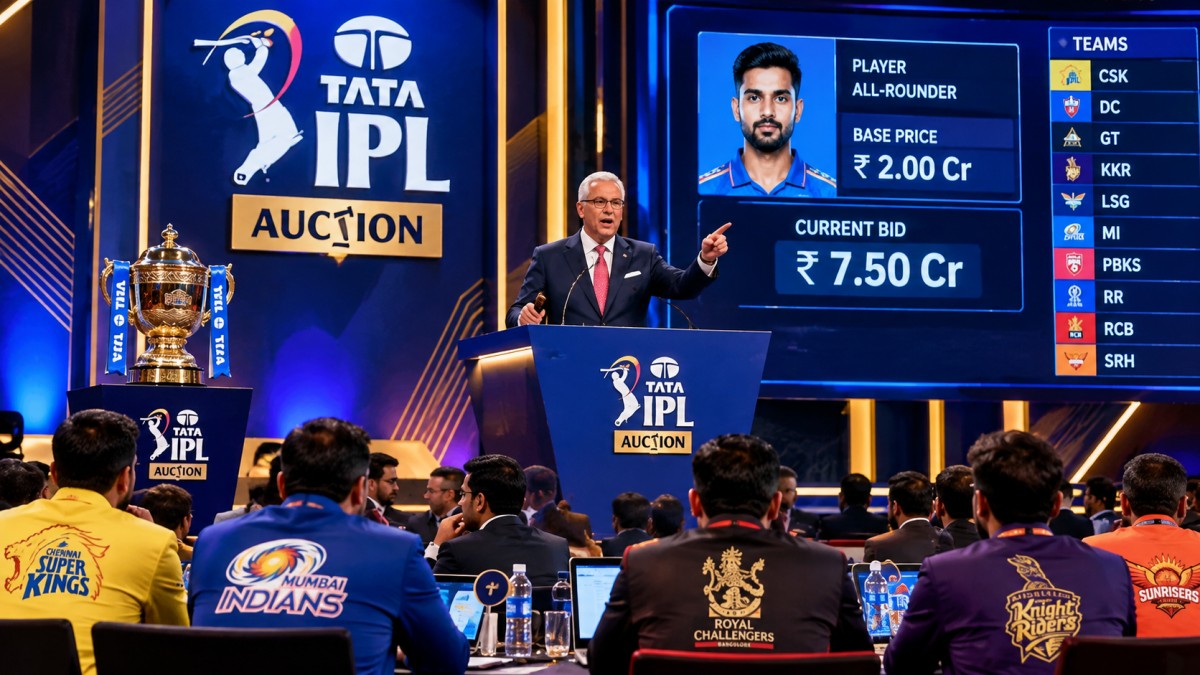
Every December, the 10 Indian Premier League franchises sit around tables in a hotel ballroom and bid crores of rupees for cricketers in a few hours. The IPL auction decides who plays for whom, and it produces some of the biggest sporting headlines of the Indian year.
The next one, the mini-auction for the 2027 season, is reported to be in Goa on 16 December 2026, with franchises due to submit their retentions by 15 November, though the IPL hasn't confirmed either date. Here's how the auction works.
Key points
- Big ("mega") auctions are held every few years; small ("mini") auctions fill gaps in between.
- Franchises keep some players through retention and buy the rest at auction from a fixed purse.
- Under the 2025–27 rules, the total salary cap is ₹146 crore (2025), ₹151 crore (2026) and ₹157 crore (2027), including the auction purse, performance pay and match fees.
- Players set a base price; bidding starts there and rises in fixed steps.
- A player bought at auction who pulls out before the season without good reason can be banned for two seasons.
How the IPL auction works
Before an auction, players register through their boards. The IPL draws up a list and groups players into sets, for example marquee players, capped batters, capped bowlers, uncapped players and so on. Each player picks a base price, the lowest price they will accept.
On the day, an auctioneer calls each player in turn. Franchises raise paddles to bid, and the price rises in set steps. The last team bidding when the auctioneer brings down the hammer buys the player. If no team bids at the base price, the player goes unsold, though unsold players can come back later in an accelerated round, where teams nominate whom they want to bid for.
A team's spending is limited by its remaining purse, and its squad must stay within the limits: a squad of 18 to 25 players, of whom no more than 8 may be overseas players. Only four overseas players can be in a playing XI.
Mega auction vs mini-auction
In a mega auction, teams release most of their players and rebuild. Before the 2025 mega auction, each team could keep up to six players through retention or the right-to-match (RTM) option, with no more than five capped players and no more than two uncapped players, according to the IPL's 2025–27 rules.
A mini-auction is smaller. Teams keep most of their squads, release a few players and bid to fill specific gaps, such as a fast bowler or a finisher. The 2027 auction is reported to be a mini-auction.
The purse and salary cap
The auction purse is the money a franchise can spend on players at auction. For the 2025 mega auction, it was ₹120 crore per team. Since 2025, the IPL has also set a wider salary cap covering the purse, incremental performance pay and match fees: ₹146 crore in 2025, ₹151 crore in 2026 and ₹157 crore in 2027, the IPL said when it announced the rules.
From 2025, each playing member, including the Impact Player, also earns a match fee of ₹7.5 lakh per game, on top of their contract.
In a mini-auction, each team's available purse depends on how much it has already committed to retained players, so the numbers differ widely between franchises.
Right to match and the overseas fee cap
Right to match (RTM): in a mega auction, a team can use an RTM card to buy back a player it released, by matching the winning bid. Under the 2025 rules, the team that won the bid gets one last chance to raise it before the RTM is used.
Overseas fee cap: to stop overseas stars skipping the big auction and waiting for higher bids in a mini-auction, the 2025–27 rules cap what an overseas player can earn at a mini-auction, linked to the top retention price. When Kolkata Knight Riders bid ₹25.20 crore for Australia's Cameron Green in the December 2025 mini-auction, the player's fee was capped at ₹18 crore under this rule, according to reports. Overseas players must also register for the mega auction to be eligible for later ones.
The capped and uncapped rule
An Indian player who hasn't played international cricket for India in the previous five calendar years, and has no BCCI central contract, counts as uncapped. Teams can retain uncapped players at a lower price, which matters for veterans who no longer play for India.
Why it matters: The IPL is one of the world's richest cricket leagues, and the auction sets the market price for cricketers far beyond India. A big auction contract can change the life of an uncapped domestic player overnight. For franchises, a good auction can decide a season, and a bad one can leave a team stuck with an unbalanced squad for years.
What to watch before the 2027 auction
- Retention lists, reported to be due by 15 November 2026: which stars are kept and which are released.
- Purse left for each team after retentions.
- Overseas availability, since international schedules affect which overseas players register.
- Uncapped Indian talent from the domestic season, including the Syed Mushtaq Ali Trophy.
Record-breaking buys
Auctions are remembered for their biggest prices. At the 2025 mega auction, Rishabh Pant became the most expensive player in IPL history when Lucknow Super Giants bought him for ₹27 crore, moments after Punjab Kings paid ₹26.75 crore for Shreyas Iyer. In the mini-auction for the 2024 season, Kolkata Knight Riders paid ₹24.75 crore for Australian fast bowler Mitchell Starc, and Sunrisers Hyderabad paid ₹20.50 crore for Pat Cummins.
Big prices don't always mean big results. Some of the most successful IPL signings have been uncapped Indian players bought at or near their base price, and teams that spend most of their purse on two or three stars can be left short of depth.
How teams plan for an auction
Franchises prepare for months. Analysts build lists of targets by role, set a maximum price for each and plan backups in case a target goes too high. Teams also think about balance: enough overseas players to fill four XI places, enough Indian fast bowlers for home pitches, and cover for injuries. During the auction, a team's strategists track every other team's remaining purse, because a rival with little money left can't compete for the next big name.
Key auction terms
- Base price: the lowest price a player accepts; bidding starts here.
- Purse: the money a franchise has left to spend at the auction.
- Marquee set: a group of star players auctioned early.
- Accelerated round: a faster round, late in the auction, for players teams nominate, including those who went unsold.
- Uncapped: an Indian player who hasn't played for India recently, under the rules above.
- Released player: a player a franchise lets go before the auction, who can then re-enter the auction pool.
The auction is part cricket, part economics and part theatre. Knowing the rules makes it easier to see which teams are building for a title and which are simply spending.
Frequently asked questions
What's Your Reaction?
 Like
0
 Dislike
0
 Love
1
 Funny
0
 Wow
0
 Sad
0
 Angry
0





Comments (0)