


India's chip plants explained, fabs, packaging and timelines
India has approved 12 chip projects: one fab, two compound fabs and nine packaging units. Which plants are running, what they make and when the first fab opens.

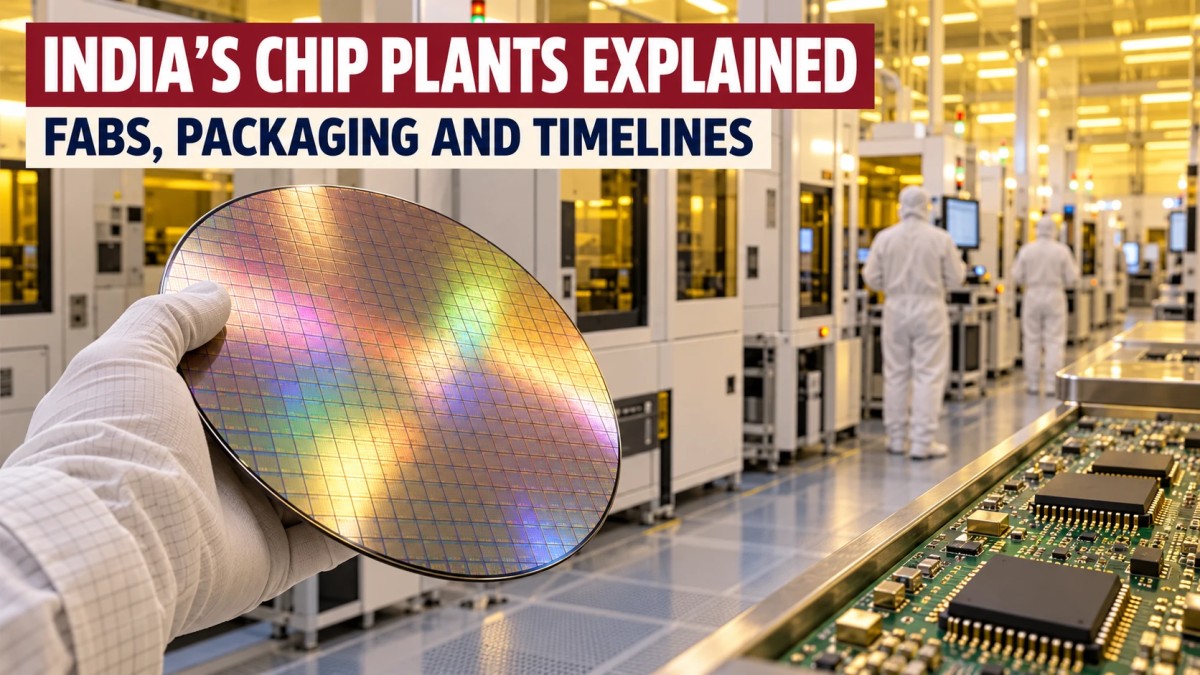
New Delhi (Desk), 18 Oct 2026 (IST) · Explainer
India has spent decades designing chips for the world's biggest technology companies without making many itself. That is starting to change. Since the India Semiconductor Mission (ISM) began in December 2021, the government has approved 12 manufacturing projects, worth about ₹1.64 lakh crore, and the first plants are now running.
But most of what India makes today is packaging and testing, not the chips themselves. This explainer sorts out what is built, what is being built, and why the difference matters.
Key points
- Approved projects: one silicon fab, two compound-semiconductor fabs and nine assembly, testing and packaging units, according to reports.
- Micron's assembly and test plant at Sanand, Gujarat, is reported to be operating; Kaynes Semicon's Sanand plant followed in 2026.
- India's first large silicon fab, by Tata Electronics with Taiwan's PSMC at Dholera, Gujarat, is under construction, with trial production reported to be targeted for December 2026.
- The first phase of ISM had a ₹76,000 crore incentive budget; a second phase has been reported at about ₹1.25 lakh crore.
- Chip-making is slow: full commercial output from the Dholera fab is widely expected only around 2028.
How a chip is made, in two halves
Making a chip has two very different stages:
- Fabrication ("front end"): circuits are built onto silicon wafers in a fab, a factory with ultra-clean rooms and machines that cost hundreds of crores each. This is the hardest, most expensive part.
- Assembly, testing, marking and packaging (ATMP or OSAT, "back end"): the finished wafers are cut into individual chips, mounted in packages, connected and tested.
Most of India's new plants are in the second category. They are cheaper and quicker to build, and they create jobs and skills, but they rely on wafers made elsewhere, mostly in Taiwan, South Korea, the US and China.
India's chip plants: what is running and what is coming
| Project | Location | Type | Status (reported) |
|---|---|---|---|
| Micron Technology | Sanand, Gujarat | Memory assembly and test | Operating since early 2026 |
| Kaynes Semicon | Sanand, Gujarat | Packaging (OSAT) | Operating since 2026 |
| CG Power with Renesas | Sanand, Gujarat | Packaging (OSAT) | First phase reported live |
| Tata Semiconductor Assembly | Jagiroad, Assam | Packaging (OSAT) | Commissioning; reports differ |
| Tata Electronics with PSMC | Dholera, Gujarat | Silicon fab | Under construction |
| HCL and Foxconn | Near Jewar, Uttar Pradesh | Display driver chip packaging | Approved |
| SiCSem and others | Odisha and other states | Compound semiconductors | Approved |
Sources: reports by industry trackers and news outlets; status changes often, so check the latest government update.
The Micron plant, India's first under the mission, was inaugurated by Prime Minister Narendra Modi in February 2026, according to reports. The Union Cabinet's approval of two smaller Gujarat units on 5 May 2026 was described by IT and Electronics Minister Ashwini Vaishnaw as the last under the first phase.
The Dholera fab
The Tata Electronics–PSMC fab at Dholera is the centrepiece. When it was approved in 2024, the government said it would cost about ₹91,000 crore and make chips at mature "nodes" (from 28 nm upward) for cars, power electronics, telecom and consumer devices, at a capacity of up to 50,000 wafers a month.
Reports in 2026 said construction had reached about halfway, with trial production targeted for December 2026 and commercial output around 2028. One tracker noted questions about whether early production will start at a larger node than first planned. Mature-node chips are not the cutting-edge processors used in top smartphones, but they are what most cars, appliances and industrial machines use.
Compound semiconductors
Two approved projects will make compound semiconductors, such as silicon carbide and gallium nitride. These are used in electric vehicle power systems, fast chargers, 5G equipment and defence electronics, where they handle high power and heat better than ordinary silicon.
Why it matters: The chip shortage of 2021 showed how a few factories in East Asia can stop car plants and phone factories worldwide. India imports almost all its chips. Making even part of the chain at home reduces that risk, creates skilled jobs and gives India a stronger hand in trade talks. For the Indian diaspora in chip design, often in the US, the plants offer a new reason to look at roles back home.
What could slow it down
- Water and power: fabs need huge amounts of ultra-pure water and uninterrupted power.
- Skills: India has many chip designers but few fab engineers; the government has set targets to train lakhs of engineers.
- Supply chain: chemicals, gases and equipment are largely imported.
- Cost: fabs are expensive to run, and global prices for mature chips can swing sharply.
- Competition: China has added large amounts of mature-node capacity, which can push down prices for the kind of chips Dholera will make first.
India's existing strength: chip design
India is already a major centre for chip design. Many of the world's biggest chip companies, including Intel, Qualcomm, Nvidia, AMD and Texas Instruments, run large design centres in Bengaluru, Hyderabad and Noida, and the government says Indian engineers make up about a fifth of the world's chip design workforce. What India has lacked is the factories to turn those designs into physical chips.
The government also runs a Design Linked Incentive scheme to help Indian start-ups design their own chips, and supports chip design courses at engineering colleges.
How the incentives work
Under the first phase of the mission, the Centre offered to cover about half of the project cost for approved fabs and many packaging units, with states often adding their own support. Gujarat, which hosts most of the early projects, offered additional subsidies and land at Dholera and Sanand. The aim was to close the cost gap with Taiwan, South Korea and China, where governments have long supported their chip industries.
The second phase is reported to shift attention to the rest of the supply chain: chemicals, gases, equipment parts and materials such as ultra-pure silicon, which India still imports.
India tried before
This is not India's first attempt at making chips. The government-run Semiconductor Complex Limited opened at Mohali in Punjab in the 1980s, but a fire in 1989 badly damaged the plant and set the effort back by years. Proposals for large commercial fabs in the 2000s and 2010s didn't reach construction, mainly because of the very high cost and the lack of a supply chain.
The difference now is the scale of government support and the involvement of experienced foreign partners, such as PSMC and Micron, along with large Indian groups such as Tata that can fund projects for years before they make money.
What "nm" means
Chip makers describe their technology in nanometres (nm). Smaller numbers mean more advanced processes that pack more transistors onto a chip. The newest smartphone processors are made at a few nanometres, a level only a handful of companies can reach. The Dholera fab will start with mature nodes, from 28 nm upward, which are cheaper to make and are used in most cars, appliances, power devices and industrial electronics.
A chip industry is built over decades, not years. India has started at the back end, as Taiwan, South Korea and China once did. Whether it can climb to the front end depends on what comes out of Dholera over the next two years.
Frequently asked questions
What's Your Reaction?
 Like
0
 Dislike
0
 Love
0
 Funny
0
 Wow
0
 Sad
0
 Angry
0






Comments (0)