


What does the President of India do? Powers explained
India's President is head of state, but acts on the Cabinet's advice. How the President is elected, the real powers, pardons, emergencies and the 2027 vote.

New Delhi (Desk), 18 Oct 2026 (IST) · Explainer
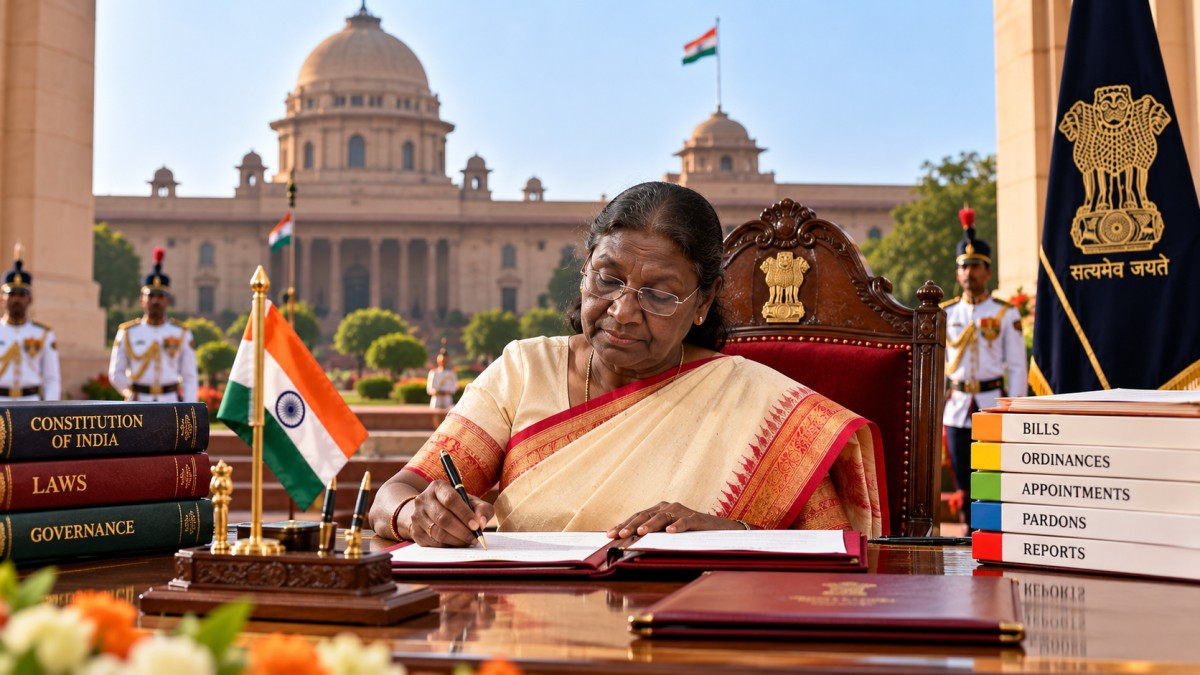
The President of India is the country's head of state, the supreme commander of its armed forces and the first citizen. Every law passed by Parliament needs the President's assent, and every Prime Minister is formally appointed by the President.
Yet day-to-day power lies with the Prime Minister and the Council of Ministers. This explainer sets out what the President actually does, how the office is filled, and where its powers end.
Key points
- The President is head of state; the Prime Minister is head of government.
- Under Article 74, the President acts on the advice of the Council of Ministers headed by the Prime Minister.
- The President is elected indirectly, by MPs and members of state legislative assemblies, for a five-year term.
- Real discretion is limited but matters: choosing a Prime Minister when no party has a majority, returning a bill once, and timing on some bills.
- Droupadi Murmu became India's 15th President on 25 July 2022; the next presidential election is due in 2027.
What does the President of India do?
The Constitution vests the executive power of the Union in the President (Article 53). In practice, that power is exercised in the President's name by the government. The main duties are:
- Appointing the government: the President appoints the Prime Minister and, on the PM's advice, other ministers.
- Appointing key officials: Chief Justice and judges of the Supreme Court and High Courts, the Chief Election Commissioner, the Comptroller and Auditor General, governors of states and the Attorney General are all appointed by the President, on the government's advice and through the processes the law sets.
- Parliament: the President summons and prorogues Parliament, can dissolve the Lok Sabha on the PM's advice, and addresses both houses at the start of the first session each year. That speech is written by the government.
- Laws: a bill becomes law only after the President's assent. The President can also issue ordinances when Parliament is not in session (Article 123), on the government's advice.
- Defence and diplomacy: the President is supreme commander of the armed forces and receives ambassadors; treaties are made in the President's name.
Head of state, not head of government
India follows the British-style parliamentary model. The 42nd Amendment (1976) made it explicit that the President "shall" act on ministerial advice, and the 44th Amendment (1978) added that the President can send advice back once for reconsideration, but must then act on it.
So when the news says "the President signed" or "the President appointed", it usually means the government decided and the President formally approved.
How the President is elected
The President is not elected by the public directly. Under Article 54, the electoral college is made up of:
- the elected members of the Lok Sabha and Rajya Sabha; and
- the elected members of the legislative assemblies of all states and of union territories with legislatures, such as Delhi and Puducherry.
Nominated members don't vote. Each vote carries a value based on population, so an MLA from a large state carries more weight than one from a small state, and MPs' votes are balanced against the total of all MLAs' votes. The vote uses a single transferable vote by secret ballot.
The President serves five years and can be re-elected. To stand, a candidate must be an Indian citizen of at least 35 who is qualified to be a Lok Sabha member. The President can be removed only by impeachment for violating the Constitution, which needs a two-thirds majority in each house. No President has ever been impeached.
The powers that do matter
The President's own judgement can come into play in a few situations:
- Choosing a Prime Minister in a hung Parliament. When no party or alliance has a clear majority, the President decides whom to invite first to form a government and prove a majority.
- Returning a bill. The President can send a bill, other than a money bill, back to Parliament once. If Parliament passes it again, the President must sign it.
- Timing. The Constitution sets no deadline for assent on ordinary bills, which has led to debate. In 1986, President Zail Singh held back the Indian Post Office (Amendment) Bill, which never became law, an example often called a "pocket veto".
- Bills from states. Governors can reserve some state bills for the President's consideration, and the President decides on them on the Union government's advice.
Pardons and emergencies
Pardons (Article 72): the President can pardon, reduce or suspend sentences, including death sentences. This too is exercised on the government's advice, after a mercy petition is examined by the Home Ministry. Courts can review such decisions in limited ways.
Emergencies: the President can proclaim three kinds of emergency, always on the Union Cabinet's written advice in the case of a national emergency since the 44th Amendment:
| Type | Article | When |
|---|---|---|
| National emergency | 352 | War, external aggression or armed rebellion |
| President's Rule in a state | 356 | When a state government can't be carried on under the Constitution |
| Financial emergency | 360 | A threat to India's financial stability |
President's Rule has been used more than 100 times since 1950. A national emergency has been declared three times, most notably in 1975. A financial emergency has never been declared.
Why it matters: The President is the keeper of the Constitution's formal machinery, and the office's neutrality matters most at moments of uncertainty: a hung Parliament, a disputed bill or a state crisis. For readers abroad who compare India with the US, the key difference is that India's President is closer to a constitutional monarch in powers, while the Prime Minister holds the executive power that a US President has.
The President and the Vice-President
The Vice-President is elected by MPs of both houses and is the ex officio Chairman of the Rajya Sabha. If the President's office falls vacant, the Vice-President acts as President until a new one is elected, which must happen within six months.
India's Presidents: a short history
Rajendra Prasad was India's first President, from 1950 to 1962, and is the only one so far to serve two full terms. Sarvepalli Radhakrishnan, a philosopher, followed him. Two Presidents, Zakir Husain and Fakhruddin Ali Ahmed, died in office.
The 1969 election was the most dramatic: V.V. Giri won as an independent candidate against the official Congress nominee, after Prime Minister Indira Gandhi called for a "conscience vote". Pratibha Patil became the first woman President in 2007. A.P.J. Abdul Kalam, the scientist known as the "missile man", served from 2002 to 2007 and remains one of the most popular holders of the office. Ram Nath Kovind served from 2017 to 2022. Droupadi Murmu, elected in 2022, is the first President from a Scheduled Tribe.
The official residence, Rashtrapati Bhavan in New Delhi, was built as the residence of the British Viceroy and is one of the largest homes of any head of state. Parts of it, including the Mughal-style gardens now called Amrit Udyan, open to the public at set times.
The President's office is designed to be above politics. Its quiet powers rarely make news, but on the few days when they're used, they can shape who governs India.
Frequently asked questions
What's Your Reaction?
 Like
0
 Dislike
0
 Love
0
 Funny
0
 Wow
0
 Sad
0
 Angry
0



Comments (0)