


How India's elections work, a plain-English guide
How India's elections work: who runs them, how nearly a billion voters register, why voting takes weeks, what EVMs are, and how NRIs can vote in India.

New Delhi (Desk), 18 Oct 2026 (IST) · Explainer
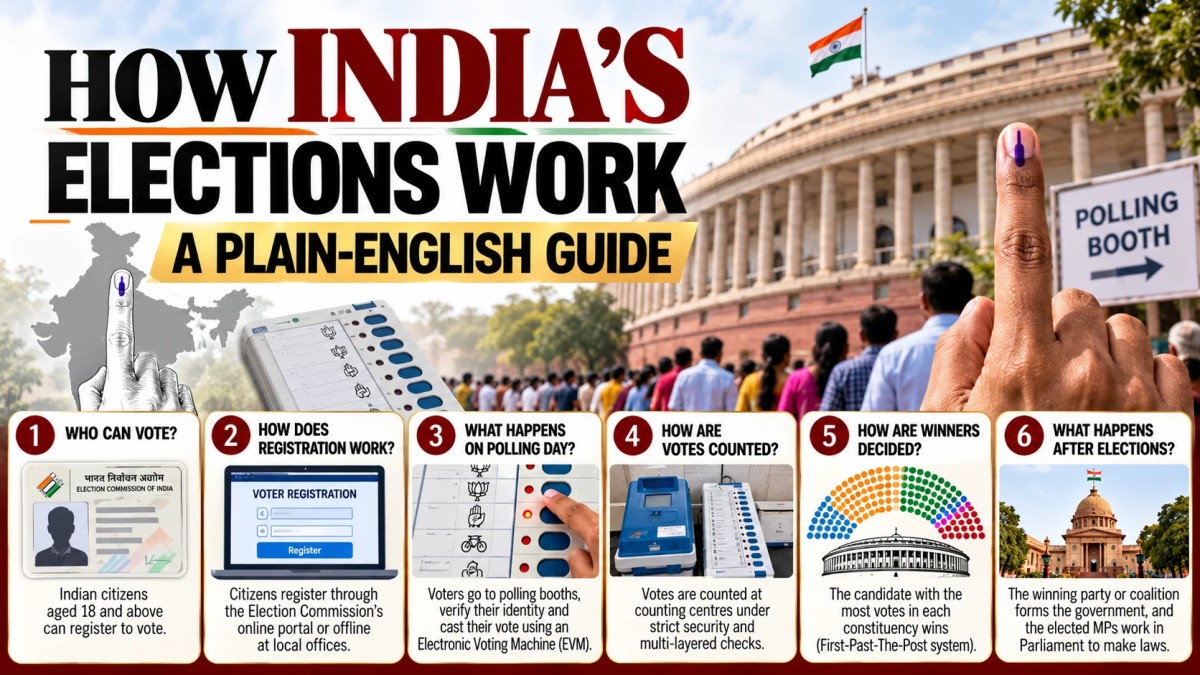
India's national election is the largest democratic exercise in the world. In 2024, about 97 crore (970 million) people were registered to vote, more than the populations of the US, the EU and Russia combined, and about 64 crore of them voted over seven phases spread across six weeks.
The basic idea is simple: voters in each of 543 constituencies elect one Member of Parliament by simple majority, and the party or alliance that can command a majority of those 543 seats, at least 272, forms the government.
Key points
- Elections are run by the Election Commission of India (ECI), an independent constitutional body.
- Every citizen aged 18 or over can register; voters are listed on electoral rolls by constituency.
- Voting uses electronic voting machines (EVMs) with a paper slip check (VVPAT) at every booth.
- National elections take place in phases over several weeks, mainly for security and logistics.
- Non-resident Indians can register as overseas voters, but must vote in person in their constituency.
Who runs India's elections
The Election Commission of India organises elections to Parliament, state legislatures, and the offices of President and Vice-President. It's set up under Article 324 of the Constitution and is led by a Chief Election Commissioner and two Election Commissioners.
During an election, the ECI takes charge of the machinery: lakhs of government employees, from teachers to police officers, are assigned to election duty under its supervision. It also enforces the Model Code of Conduct, a set of rules for parties, candidates and governments that comes into force when an election is announced. Under it, for example, governments can't announce new schemes that might sway voters.
Who can vote, and how voters are registered
Any Indian citizen aged 18 or over on the qualifying date can register in the constituency where they ordinarily live. Voters are listed on electoral rolls, which are revised every year and before elections, and receive an Elector's Photo Identity Card (EPIC).
Electoral rolls are updated through claims and objections: people apply to be added, to correct details, or to remove names of those who've died or moved. Since 2025, the ECI has also been carrying out a Special Intensive Revision (SIR), a house-to-house re-verification of the rolls in phases across the country, which has drawn legal challenges and protests. The Supreme Court upheld the exercise in May 2026.
How India's elections work on polling day
Electronic voting machines (EVMs) have been used across India since the early 2000s. A voter presses a button next to the name and symbol of their chosen candidate. Since the 2019 general election, every EVM has been paired with a VVPAT (Voter Verifiable Paper Audit Trail), which shows the voter a printed slip with their choice for about seven seconds before it drops into a sealed box. Slips from a sample of machines in each constituency are counted and matched against the EVM count.
Voters also have the option of NOTA, "None of the Above", available since 2013. NOTA votes are counted but don't affect who wins: even if NOTA gets the most votes, the candidate with the highest number of votes is still elected.
After voting, an official marks the voter's left index finger with indelible ink, to stop anyone voting twice. The ink lasts for days, and it's made by a single state-owned company in Karnataka, Mysore Paints and Varnish, which has supplied it for decades.
There were about 10.5 lakh polling stations in 2024, set up so that, in principle, no voter has to travel more than 2 km to vote. Some are in very remote places: the ECI regularly sets up booths for a handful of voters in forests and high mountains. Polling teams travel by boat, on foot, on horseback and by helicopter to reach them, carrying the machines with them.
Why voting takes weeks
National elections are held in phases, with different states and constituencies voting on different days. In 2024 there were seven phases, from 19 April to 1 June, and votes were counted on 4 June.
The main reason is security. Central armed police forces are moved from state to state to guard polling stations and ballot-carrying machines, and there aren't enough to cover the whole country on one day. Weather, school exams, festivals and the sheer distances involved also shape the schedule.
All results are declared together on counting day, when EVMs are opened under the watch of candidates' agents. Most results come in within a day.
Why it matters: India's elections decide the government of one in six people on Earth, and their credibility depends on trust in the rolls, the machines and the Election Commission. For readers abroad, India is proof that elections can work at a scale few countries attempt, and a place where questions about voter lists, like those raised during the SIR, can affect hundreds of millions of people at once.
From votes to government
India uses first-past-the-post: in each constituency, the candidate with the most votes wins, even without a majority. A party can win a large share of seats with well under half the national vote.
After results, the President of India invites the leader of the party or alliance most likely to command a majority in the Lok Sabha to form a government and become Prime Minister. If no party has a majority on its own, as in 2024, coalitions and pre-poll alliances decide who governs.
States elect their own legislative assemblies in the same way, usually on separate schedules, and their governments run areas such as police, health and agriculture.
Below the states sit panchayats (village councils) and municipal bodies, elected under the supervision of each state's own State Election Commission, not the ECI. Together, India elects millions of local representatives, and a third of local seats are reserved for women under constitutional amendments passed in the early 1990s.
Exit polls and the silence period
Two rules shape how elections are reported. Publishing exit polls is banned from the start of polling in the first phase until half an hour after the last phase closes, under Section 126A of the Representation of the People Act. And in the 48 hours before polling ends in a constituency, campaigning there must stop, the so-called silence period. Newsrooms, including this one, follow both rules on every platform.
How NRIs can vote
Indian citizens living abroad who haven't taken another country's citizenship can register as overseas electors, using Form 6A on the ECI's voter portal, in the constituency of the address on their Indian passport.
The catch: they must vote in person, at their polling station in India, on polling day, showing their original passport. There's no postal, online or embassy voting for overseas voters. Proposals to allow proxy or electronic postal voting for NRIs have been discussed for years but haven't become law, so turnout among registered overseas electors stays very low.
People who hold an OCI card, and so are foreign citizens, can't vote in Indian elections.
Every Indian election produces the same image: a long, patient queue outside a school building, in heat, rain or snow. It's the least dramatic part of the process, and the part that tells you the most about why it keeps working.
Frequently asked questions
What's Your Reaction?
 Like
0
 Dislike
0
 Love
0
 Funny
0
 Wow
0
 Sad
0
 Angry
0




Comments (0)