


Lok Sabha vs Rajya Sabha, India's two houses explained
The Lok Sabha and Rajya Sabha explained: who sits in each, how members are chosen, which house is more powerful, and how a bill becomes law in Parliament.

New Delhi (Desk), 18 Oct 2026 (IST) · Explainer
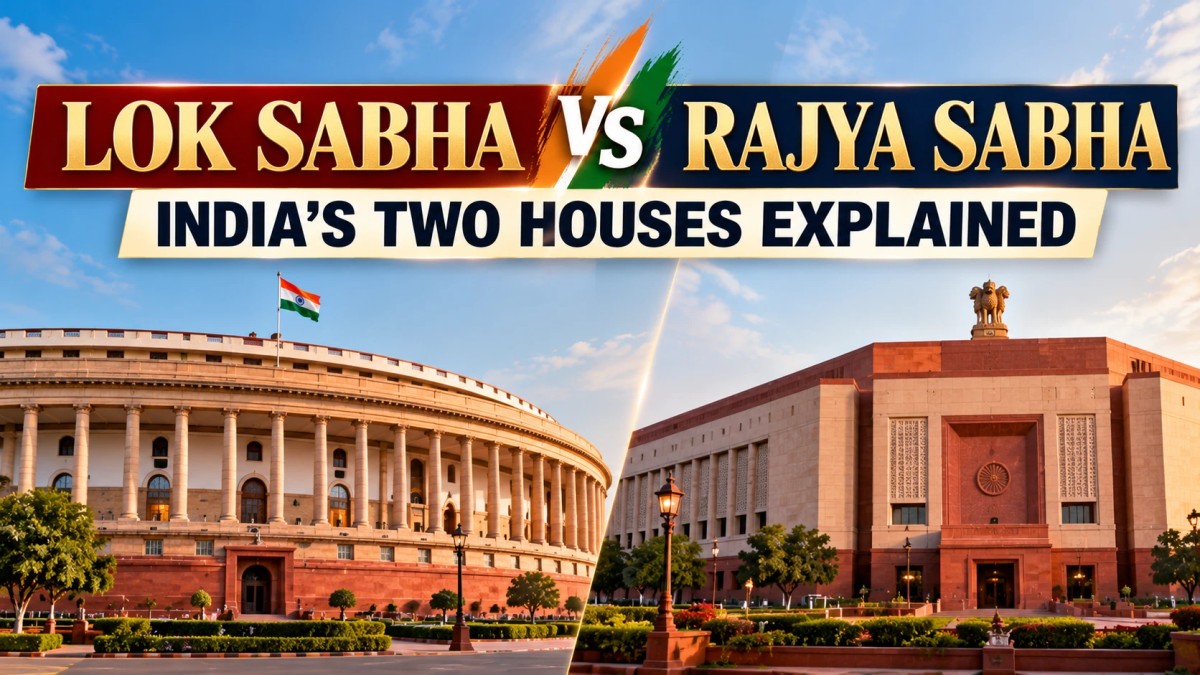
India's Parliament has two houses. The Lok Sabha, the "House of the People", is directly elected by voters and decides who governs. The Rajya Sabha, the "Council of States", is elected indirectly by state legislatures and acts as a revising chamber that represents the states.
In most matters, laws need the approval of both. But the Lok Sabha has the upper hand on money and on the survival of the government.
Key points
- Lok Sabha: 543 elected members, chosen directly by voters, for up to five years.
- Rajya Sabha: up to 250 members (currently 245), 233 elected by state and union territory legislators and 12 nominated by the President.
- The government must keep the confidence of the Lok Sabha; the Rajya Sabha can't bring it down.
- On money bills, the Rajya Sabha can only suggest changes, within 14 days.
- The Rajya Sabha is never dissolved: one-third of its members retire every two years.
Lok Sabha vs Rajya Sabha: the basics
| Lok Sabha | Rajya Sabha | |
|---|---|---|
| Name means | House of the People | Council of States |
| Members | 543 elected | 245 (233 elected + 12 nominated) |
| Chosen by | Voters, directly | Elected members of state and UT legislatures |
| Term | Up to 5 years, unless dissolved earlier | 6 years per member; the house is permanent |
| Presiding officer | Speaker | Vice-President of India, as Chairman |
| Minimum age to be a member | 25 | 30 |
The Lok Sabha: where governments are made
Each of the 543 Lok Sabha members represents a constituency, roughly equal in population when boundaries were last drawn. Seats are allocated to states broadly by population, so Uttar Pradesh has 80 and smaller states have one or two.
The Prime Minister and the government must keep the support of a majority in the Lok Sabha. If they lose a no-confidence motion there, they have to resign. That power belongs only to the Lok Sabha.
The Lok Sabha is elected for up to five years. The President can dissolve it earlier on the advice of the government, which triggers a fresh election.
The number of seats has been frozen since the 1970s, on the basis of the 1971 Census. Under the Constitution, it can be redrawn after the first census taken after 2026. A fresh delimitation would also bring into effect the reservation of one-third of Lok Sabha seats for women, passed in 2023.
The Rajya Sabha: the states' chamber
Rajya Sabha members are elected by the elected members of each state's legislative assembly, and of the union territories that have legislatures, using a system of proportional representation by single transferable vote. The number from each state depends broadly on population.
The President also nominates 12 members with special knowledge or practical experience in literature, science, art and social service.
Because a third of members retire every two years, the Rajya Sabha changes slowly, and often reflects which parties held power in the states several years earlier. That's why a government can have a big Lok Sabha majority and still struggle to pass laws in the Rajya Sabha. It has happened to governments of different parties, and it's one reason the Rajya Sabha is sometimes called the house of second thoughts: bills that pass the Lok Sabha quickly can be delayed, amended or sent to committees there, giving more time for scrutiny and for state concerns to be heard.
How a bill becomes law
- Introduction. Most bills can start in either house. Money bills must start in the Lok Sabha.
- Debate and committees. Bills may be sent to a parliamentary committee for detailed study, then debated and voted on, clause by clause.
- The other house. The bill goes to the second house, which can pass it, amend it or reject it.
- Disagreement. If the houses disagree on an ordinary bill, the President can call a joint sitting, where members of both houses vote together. Because the Lok Sabha is about twice the size, its majority usually prevails.
- Presidential assent. The President signs the bill, sends it back for reconsideration once, or, for some bills, keeps it pending. Once signed, it becomes an Act.
Money bills are different. The Rajya Sabha can't reject or amend them; it can only recommend changes within 14 days, which the Lok Sabha can accept or ignore. The Speaker decides whether a bill is a money bill.
Constitutional amendments need a special majority in each house separately, and some also need approval by half the state legislatures. There's no joint sitting for them.
Why it matters: The balance between the two houses decides how easily any Indian government can change laws, from taxes to labour rules to elections. For readers abroad, the Rajya Sabha is a reminder that India is a federal union: the states have their own voice in Parliament, even if the Lok Sabha has the last word on money.
How MPs hold the government to account
Laws are only part of Parliament's job. Each sitting day usually starts with Question Hour, when MPs ask ministers questions, some answered orally on the floor, many more in writing. It's followed by Zero Hour, an informal slot where members raise urgent issues without notice.
Much of the detailed work happens in committees. There are standing committees for each group of ministries, which examine bills and budgets away from the cameras, and financial committees such as the Public Accounts Committee, which reviews the government's spending using the reports of the Comptroller and Auditor General. By long convention, the Public Accounts Committee is chaired by a member of the opposition.
The anti-defection law, added to the Constitution in 1985 as the Tenth Schedule, means an MP who votes against their party's instructions, or leaves it, can be disqualified, unless enough of the party merges with another. It keeps governments stable, but critics say it also weakens debate, because MPs rarely vote against their party, even on issues where their constituents disagree with it.
Sessions, and where Parliament meets
The Budget session is the longest and most important: the Finance Minister presents the Union Budget, usually on 1 February, and both houses debate the government's spending plans ministry by ministry before passing the Finance Bill and the appropriation bills that let the government spend money.
Parliament usually meets three times a year: the Budget session (from late January), the Monsoon session (July–August) and the Winter session (November–December). Each session is summoned by the President on the government's advice, and the gap between two sessions can't exceed six months under the Constitution. The 2026 winter session is reported to be planned for mid-November to mid-December, though dates hadn't been officially announced as of 18 October.
Since 2023, both houses have met in the new Parliament building in New Delhi, which has room for 888 members in the Lok Sabha chamber and 384 in the Rajya Sabha chamber, space for an expanded Parliament after future delimitation.
Parliament can look like noise from outside: walkouts, adjourned sessions and shouting on the evening news. Underneath, the two-house design does what it was built to do. It makes big change possible, but slower, and it forces the Centre to keep at least one eye on the states.
Frequently asked questions
What's Your Reaction?
 Like
0
 Dislike
0
 Love
0
 Funny
0
 Wow
0
 Sad
0
 Angry
0





Comments (0)