


Lakh and crore explained in millions, billions and dollars
What lakh and crore mean, how Indians place commas, and how to convert ₹ figures into millions, billions and dollars quickly, with examples from the news.

New Delhi (Desk), 18 Oct 2026 (IST) · Explainer
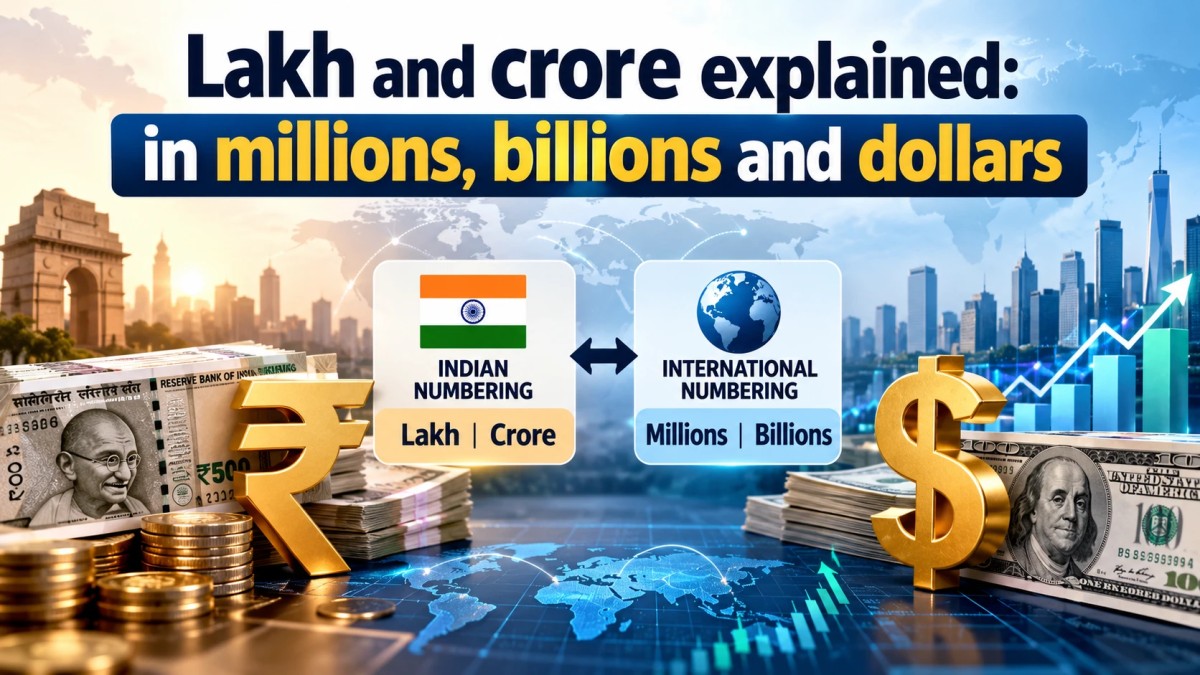
Two words cause more confusion for readers of Indian news than almost any others: lakh and crore. A lakh is 100,000. A crore is 10 million. And a "lakh crore", a phrase you'll see in every Indian budget story, is one trillion.
Once you know those three, almost any Indian number becomes easy to translate, whether it's in a budget speech, a salary offer or a property listing.
Key points
- 1 lakh = 100,000 (one hundred thousand).
- 1 crore = 10,000,000 (ten million) = 100 lakh.
- 1 lakh crore = 1,000,000,000,000 (one trillion).
- Indians place commas differently: 1,00,00,000 rather than 10,000,000.
- At about ₹97 to the US dollar, ₹1 crore is roughly $103,000 and ₹1 lakh crore is roughly $10.3 billion.
Lakh and crore in millions: the quick table
| Indian term | Number | International | Rough US dollars at ₹97 |
|---|---|---|---|
| 1 thousand | 1,000 | one thousand | about $10 |
| 1 lakh | 1,00,000 | one hundred thousand | about $1,030 |
| 10 lakh | 10,00,000 | one million | about $10,300 |
| 1 crore | 1,00,00,000 | ten million | about $103,000 |
| 100 crore | 1,00,00,00,000 | one billion | about $10.3 million |
| 1 lakh crore | 1,00,00,00,00,00,000 | one trillion | about $10.3 billion |
Notice the jump from 10 lakh to 1 crore: 10 lakh is a million, so 1 crore, at 100 lakh, is ten million.
Why India counts this way
The Indian numbering system groups digits differently. After the first three digits from the right (the hundreds), commas come every two digits instead of every three:
- International: 12,345,678
- Indian: 1,23,45,678 (one crore, twenty-three lakh, forty-five thousand, six hundred and seventy-eight)
The system is centuries old and is used across South Asia, including Pakistan, Bangladesh, Nepal and Sri Lanka. Indian law, banks, the government and most newspapers use it, which is why official figures arrive in crores and lakhs.
In words, the Indian place values run: ones, tens, hundreds, thousands, ten thousands, lakhs, ten lakhs, crores, ten crores, and so on. So a number like 4,56,78,901 is read as "four crore, fifty-six lakh, seventy-eight thousand, nine hundred and one".
The rupee itself is divided into 100 paise, though coins below one rupee are now rarely used. The ₹ symbol was adopted in 2010, based on a design by D. Udaya Kumar that combines the Devanagari letter "ra" with the Latin "R".
Older terms exist for bigger units, such as arab (100 crore, or one billion) and kharab (100 arab), but they're rare in modern news. Indians usually say "lakh crore" instead.
How to convert quickly in your head
Three shortcuts cover most cases.
Crore to million: multiply by 10. ₹50 crore = ₹500 million. ₹5,000 crore = ₹50,000 million = ₹50 billion.
Lakh crore to trillion: it's the same number. ₹2 lakh crore = ₹2 trillion.
Rupees to dollars: divide by the exchange rate. At about ₹97 to the dollar, divide by roughly 100 and add 3%. So ₹1 crore ≈ $103,000, and ₹10 lakh crore ≈ $103 billion.
A handy check: if a dollar figure seems absurdly large or small, you've probably mixed up a lakh and a crore.
Going the other way is just as easy. To turn millions into crores, divide by 10: $1 million is about ₹9.7 crore at ₹97 to the dollar. To turn billions into lakh crore, divide by 1,000: ₹2,500 billion is ₹2.5 lakh crore.
Worked examples from the news
These are taken from recent National Diaries stories:
- Government spending: the Cabinet approved ₹53,428 crore over five years for the National Social Assistance Programme. That's ₹534.28 billion, or about $5.5 billion.
- Digital payments: UPI, India's instant payment system, handled ₹29.37 lakh crore in September 2026. That's ₹29.37 trillion, or roughly $300 billion, in one month.
- Pensions: the disability pension of ₹375 a month is about $3.90.
- Bank deposit insurance: deposits are insured up to ₹5 lakh per depositor per bank, about $5,150.
- Salaries: an annual package of ₹24 lakh is ₹2.4 million, about $24,700.
Why it matters: Indian budgets, company results, property prices and salaries are almost all quoted in lakhs and crores, and foreign readers often misread them by a factor of ten or a hundred. For Indians abroad, converting confidently matters for everything from comparing salary offers to understanding a home loan. National Diaries gives approximate dollar figures in its stories for exactly this reason.
Lakh and crore in everyday India
You'll meet these words long before you read a Budget. A few common uses:
- Salaries are usually quoted per year in lakhs, often as "LPA" (lakhs per annum). A "12 LPA" job pays ₹12 lakh a year, about $12,400.
- Property prices run in lakhs and crores. A "₹1.5 crore flat" costs ₹15 million, about $155,000.
- Company results are reported in crores. "Revenue of ₹10,000 crore" is ₹100 billion, about $1 billion.
- The national Budget and GDP are reported in lakh crore. India's economy is measured in hundreds of lakh crore of rupees.
- Population is often given in crores too: "140 crore Indians" means 1.4 billion people.
In Hindi and many other Indian languages, the words are almost the same: लाख (lākh) and करोड़ (karoṛ). In English-language Indian media, they're written as lakh and crore, usually without a plural "s".
Indian numbers in a spreadsheet
If you work with Indian figures in Excel or Google Sheets, you can display numbers in the Indian comma style without changing the values. A custom number format commonly used for this is:
[>=10000000]##\,##\,##\,##0;[>=100000]##\,##\,##0;##,##0
It places commas at lakh and crore positions for numbers up to about ten thousand crore. Many accounting packages used in India also have an "Indian number format" setting built in. To convert a column from rupees to crores, simply divide by 1,00,00,000 (10 million); to convert to lakhs, divide by 1,00,000.
How National Diaries writes Indian numbers
Because our readers are in India and around the world, we follow a few simple rules:
- On first mention, we give the Indian unit with its international equivalent: "₹500 crore (₹5 billion)".
- Where it helps, we add an approximate US dollar figure, and say which exchange rate we used.
- We don't mix units in one sentence, and we round sensibly: "about $5.5 billion", not "$5,508,041,237".
- For pounds or euros, we convert at the day's rate when a story is mainly for readers in the UK or Europe.
If you see a conversion on our site that looks wrong, tell us through the contact page; we correct errors with a dated note.
Common mistakes to avoid
- Treating a crore as a million. It's ten million. "₹100 crore" is ₹1 billion, not ₹100 million.
- Mixing currencies and units. "₹2 lakh crore" is a rupee amount; in dollars it's about $20 billion, not $2 trillion.
- Comma confusion in spreadsheets. Indian-format numbers pasted into software set to international format can be misread. Strip the commas before converting.
- Forgetting exchange rates move. The rupee was around ₹97 to the dollar in October 2026; a few years ago it was much stronger. Always check the date of a conversion, especially in older articles, where a dollar figure may reflect a very different rupee rate from today's.
Learn three numbers, 100,000, ten million and one trillion, and Indian economics news stops being a puzzle. The rest is just multiplying by ten and dividing by the rupee rate of the day.
Frequently asked questions
What's Your Reaction?
 Like
0
 Dislike
0
 Love
0
 Funny
0
 Wow
0
 Sad
0
 Angry
0







Comments (0)