


 US Visas
H-1B extensions may get tougher under the DHS deference rule
The US has proposed that officers stop deferring to earlier approvals when deciding H-1B and L-1 extensions. What changes for Indians, and how to comment.

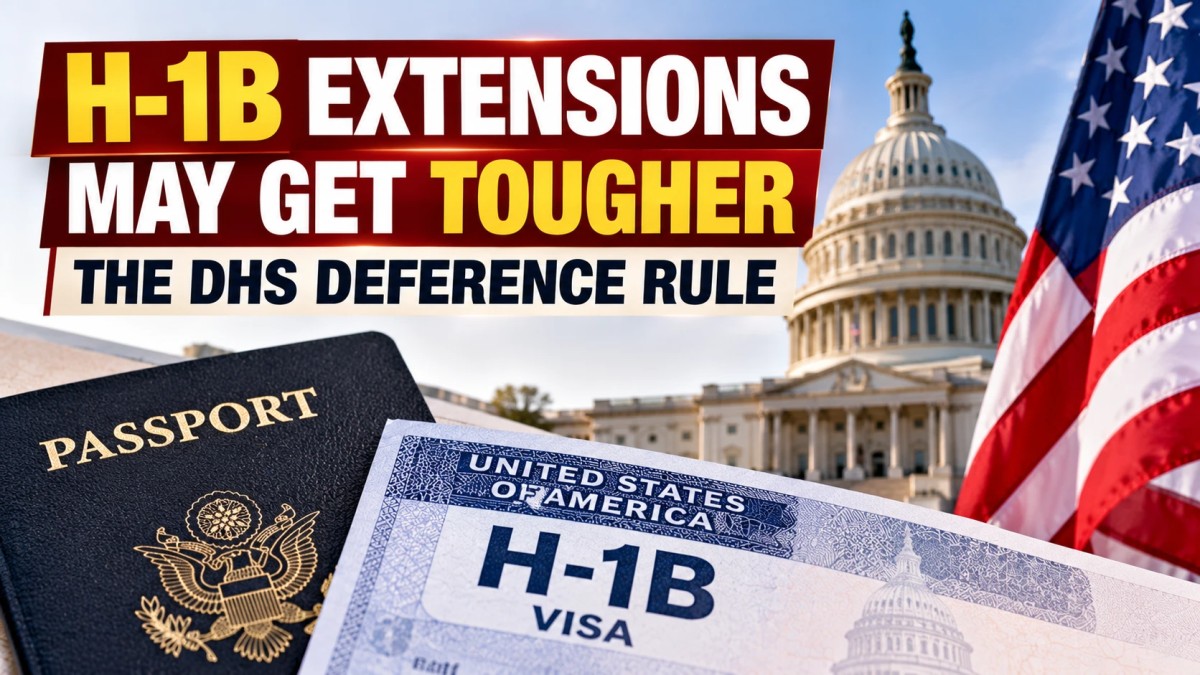
Renewing an H-1B in the United States could soon mean proving your case almost from scratch. On 14 October 2026, the US Department of Homeland Security (DHS) proposed ending a rule that tells immigration officers to give weight to their own earlier approval when the same worker, the same employer and the same job come back for an extension.
It's only a proposal. The current rule stays in force until a final rule is published, and anyone can comment until 13 November 2026.
Key points
- DHS proposes removing 8 CFR 214.1(c)(5), the "deference" rule written into US regulations in December 2024.
- Officers could still look at a prior approval, but would no longer start from the presumption that it was right.
- The change would cover every Form I-129 category, including H-1B, L-1, O-1, TN and E visas.
- DHS expects about 6,000 more Requests for Evidence a year; comments are due by 13 November 2026.
- It doesn't cancel H-1B extensions or revoke any visa.
What the DHS proposal says
The proposed rule was published in the Federal Register on 14 October as 91 FR 65119, under docket USCIS-2026-0529, according to the law firm Duane Morris. It would delete one paragraph of US regulations, 8 CFR 214.1(c)(5).
That paragraph currently requires US Citizenship and Immigration Services (USCIS) to defer to a previous decision when an extension involves the same parties and the same underlying facts. Officers can only depart from it if there was a material error, a material change in circumstances, or new information that hurts eligibility. Today, if an officer decides not to defer, guidance requires them to explain why and get a supervisor's approval.
Under the proposal, that presumption goes. Officers could still consider the earlier approval as evidence, but they'd judge each extension on its own record.
The H-1B extension deference rule: a policy that keeps flipping
Deference isn't new, and that's part of why employers are frustrated. USCIS first told officers to defer to earlier approvals in a 2004 memo, citing consistency and efficiency. The Trump administration rescinded that guidance in 2017. The Biden administration restored it in 2021 and then wrote it into the regulations in December 2024, as part of the H-1B modernisation rule. Now DHS wants to remove it again.
DHS argues that deference shifts the burden of proof from the employer to the officer, discourages officers from asking for evidence, and lets wrong or fraudulent approvals carry forward year after year, Duane Morris reported.
Supporters of deference say the opposite: that an employer who's already proved a job qualifies shouldn't have to prove it again when nothing has changed, and that re-checking the same facts wastes time for everyone.
What it would mean in practice
The clearest effect is more paperwork and more waiting. DHS estimates that deference currently applies to about 208,429 petitions a year, and expects roughly 6,044 extra Requests for Evidence (RFEs) annually if it goes. An RFE is a formal request from USCIS for more documents before it decides. Petitions that receive one took a median of 64 more days to decide, according to the figures reported by Duane Morris.
For a worker, an RFE on an extension usually isn't a disaster on its own, because people who file for an extension on time can generally keep working for the same employer while it's pending, under existing rules. But it adds cost, delay and uncertainty, especially for anyone planning international travel or a visa stamp abroad.
The change would hit same-employer extensions hardest, because those are where deference does most of its work. It could also affect some amended petitions.
Put the DHS numbers side by side and the scale becomes clearer. Roughly 6,000 extra RFEs on about 208,000 petitions is around three in every hundred. That sounds small until you remember who files extensions most often.
Why Indians in the green card queue feel it most
An Indian H-1B worker waiting for a green card can be stuck in the queue for well over a decade, because US law caps green cards per country and Indian demand far exceeds India's share. While they wait, they stay in the US through repeated H-1B extensions, often every one to three years, under the rules for people with a pending or approved green card petition.
That means an Indian engineer who arrived in 2015 may already have filed four or five extensions with the same employer, for the same job. Under deference, each new extension mostly confirmed what USCIS had already accepted. Without it, each one becomes a fresh review of the same facts, with a fresh chance of an RFE, and a fresh delay.
For families planning visa-stamping trips to India, that delay matters. Travel usually waits until an extension is approved, so a 64-day slowdown can mean a missed wedding or a postponed visit to ageing parents.
Why it matters: Indians receive most H-1B approvals, so any change to how extensions are decided falls mainly on Indian families. For readers outside the US, it's part of a wider tightening of skilled immigration this autumn, alongside the green card freeze at eight large employers and a proposed fee on student work permits.
The second change, for spouses' work permits
DHS released a separate final rule on the same day that ends automatic extensions of employment authorisation for most categories of Employment Authorization Documents (EADs), Duane Morris said. EADs are the cards that let certain visa holders and dependants work in the US. The firm noted the change affects dependants such as many H-4 spouses, the husbands and wives of H-1B workers, a group that is mostly Indian because most H-1B workers are.
Until now, many renewal applicants could keep working for a period while their new EAD was processed. Losing that cushion means a spouse could have to stop work if a renewal is slow.
This one is a final rule, not a proposal. Check its effective date and exact scope in the Federal Register before relying on any summary, including this one.
What workers and employers can do now
None of this is legal advice, and every case is different. Immigration lawyers commenting on the proposal have suggested some practical steps:
- File early. For petitions expiring in the next year, start sooner and allow time for a possible RFE.
- Treat every extension as a full filing. Document eligibility again, rather than relying mainly on the last approval and a short employer letter.
- Check consistency. Compare the new filing with earlier petitions, Labor Condition Applications and visa applications, and explain any change in duties, worksite, pay or company structure up front.
- Keep records. Hold on to every earlier petition, RFE response and approval notice.
- Consider premium processing if timing matters, for an extra fee.
- For H-4 spouses: file EAD renewals as early as the rules allow, and plan for a possible gap.
How to comment on the proposal
Comments must go through regulations.gov, using docket number USCIS-2026-0529, by 13 November 2026. Comments sent by email, post or hand delivery won't be considered, and everything submitted, including personal details, is published. Individual workers, employers, universities and lawmakers can all comment, and DHS must consider the comments before issuing a final rule.
There's a quiet cost here that doesn't show up in the docket. For hundreds of thousands of Indian families, an extension used to be a routine form. If this goes through, it becomes a test they have to pass again every few years, on facts that haven't changed.
This article is general information, not legal advice.
Frequently asked questions
What's Your Reaction?
 Like
0
 Dislike
0
 Love
0
 Funny
0
 Wow
0
 Sad
0
 Angry
0





Comments (0)