


 Study in USA
What the $70,000 OPT fee means for Indian students in the US
The US has proposed charging colleges $70,000 for each student's OPT work permit and $30,000 for extensions. What it means for Indian students and what's next.

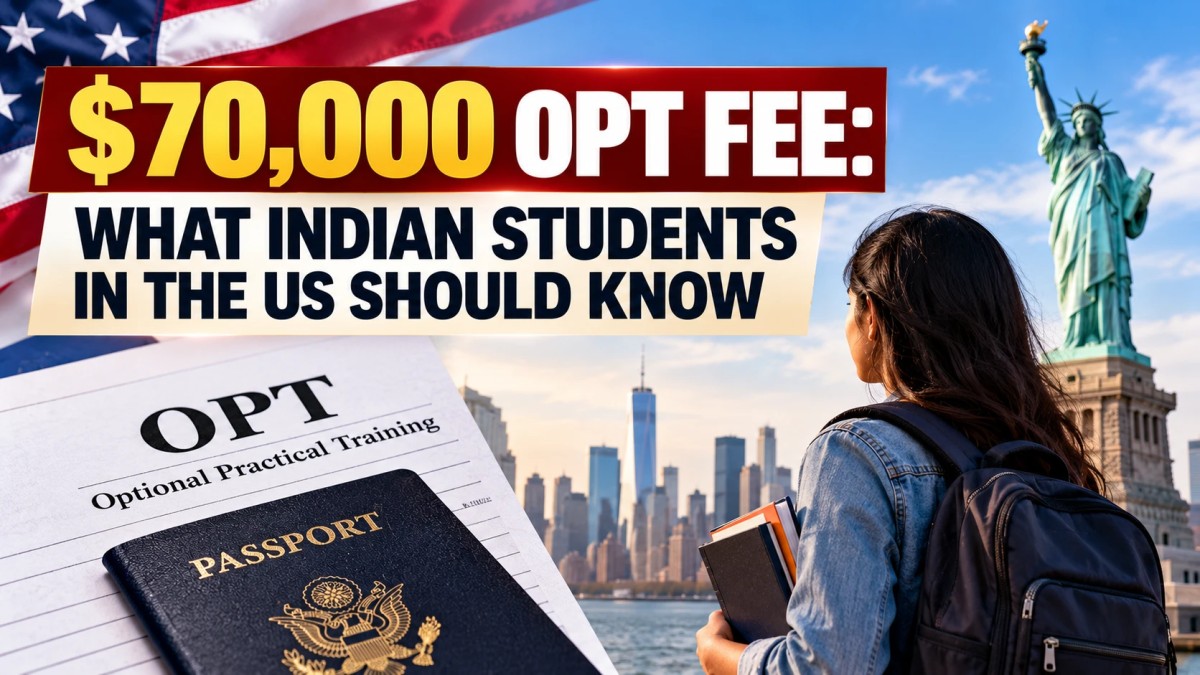
The US government wants colleges to pay $70,000 (about ₹68 lakh) for every international student it recommends for Optional Practical Training (OPT), the work permit most foreign graduates use after a US degree. Each later round, including the STEM extension, would cost another $30,000 (about ₹29 lakh).
It isn't in force. The Department of Homeland Security (DHS) published it as a proposal on 8 October 2026, comments are open until 9 November, and it's expected to face court challenges.
Key points
- DHS proposes a $70,000 fee per student for initial OPT and $30,000 for each further OPT period, including STEM extensions.
- Colleges would pay, but DHS acknowledges they "may pass the financial obligation" to students or employers.
- Today, a student pays about $520 to apply for OPT.
- The fee would start 60 days after a final rule; comments close on 9 November 2026.
- India sends more students to the US than any other country, so the change would hit Indian families hardest.
What the OPT fee proposal says
DHS announced the plan on 7 October and published it in the Federal Register the next day, TIME reported. Under it, a US college would pay $70,000 for each student it recommends for initial OPT, and $30,000 for each additional OPT period. The money would go to the US Treasury, not to DHS, according to the American Council on Education (ACE).
OPT lets F-1 students work in their field for up to 12 months, during or after their studies. Graduates in science, technology, engineering and maths (STEM) can extend that by 24 months. Many use the time to find an employer who will sponsor an H-1B visa.
The current fee is about $520, paid by the student to process the work permit.
Why DHS says it needs the fee
DHS calls OPT an "uncontrolled guest worker pipeline" and a "magnet for fraud", TIME reported. In May, it said it had found more than 10,000 foreign students who claimed to work for "highly suspect employers", with investigators alleging phantom employees and empty buildings at listed workplaces.
The department argues that the programme has grown faster than it can check employers, and that OPT is being used to get around the H-1B system. It says a large fee would push colleges to be more selective about whom they recommend. A DHS spokesperson said OPT "was never meant to be a back door into the American workforce".
DHS granted 194,554 OPT work permits in 2024, up from 160,627 in 2023, according to figures cited by TIME.
OPT fee 70000: who would actually pay
On paper, colleges pay. In practice, most expect students to. Sarah Spreitzer of ACE, which represents US universities, said colleges "would likely pass that fee along to the student in the form of tuition and fees".
For an Indian student, that could add tens of lakhs of rupees to the cost of a US master's degree, on top of tuition and living costs that already run high. A survey released on 6 October by the Institute for Progress, a Washington think tank, found that far fewer international students said they'd try to stay and work in the US if the fees were introduced. Only 15% of OPT-eligible STEM students said they'd be likely to stay.
Some universities might absorb part of the cost for students they want to keep, especially in research-heavy fields. Others might simply recommend fewer students for OPT. Neither has been decided anywhere yet.
How OPT connects to the H-1B
OPT matters so much because it's usually the bridge to a longer work visa. Most employers can only file for an H-1B once a year, through a lottery, so graduates rely on OPT to keep working while they try. STEM graduates get up to three years in total, which means up to three attempts. If an H-1B petition is filed for them, the "cap-gap" rule can extend their OPT until the new visa starts on 1 October.
STEM OPT also comes with conditions: the employer must use E-Verify, the US government's employment check system, and must agree a formal training plan with the student. These rules already exist; the proposal adds a cost on top of them.
That's why a fee on OPT is really a fee on the H-1B pathway itself. If fewer students can afford OPT, fewer will ever enter the H-1B lottery, which is exactly the outcome some in the administration want and many US employers don't.
Why it matters: India has been the largest source of international students in the US in recent years, and Indians make up a large share of OPT workers. For families in India, the US degree has long been sold as a path to a US job; this proposal would put a very large price on the first step of that path. For US universities, it threatens one of the main reasons students choose America over the UK, Canada, Australia or Germany.
The legal fight ahead
The proposal is widely expected to be challenged in court. Doug Rand, a former Biden administration adviser who now runs the Talent Mobility Fund, wrote on LinkedIn: "Don't Panic: DHS has no authority to slap a $70k fee on international students." He told TIME the proposal "isn't going to fare well in the courts".
There's precedent. Courts have blocked the $100,000 H-1B fee, with a second judge ruling against it on 1 October, according to TIME. Separately, US university groups sued on 5 October over new limits on Curricular Practical Training (CPT), the work option during a degree, and a federal judge has blocked a DHS rule that would have replaced open-ended student stays with fixed periods; the government has appealed.
ACE has said it will ask DHS to withdraw the OPT proposal. Todd Schulte of the advocacy group FWD.us said the US "is intentionally pricing itself out of the global market for top talent".
What Indian students and families can do now
None of this is legal or financial advice. For students already in the US, or about to go:
- Don't panic-change plans yet. The fee isn't law. If it's finalised, it would start 60 days after the final rule, and courts may pause it.
- Ask your university. International student offices will know how the college plans to respond and whether it intends to pass on any fee.
- Check your timeline. Students graduating in the next few months may be able to apply for OPT before any final rule takes effect.
- For 2027 admissions: compare total costs, including possible post-study work costs, with alternatives in the UK, Canada, Australia, Ireland and Germany, each of which has its own post-study work rules.
- Comment. Students, parents and employers can comment on the Federal Register notice until 9 November.
For a generation of Indian engineers, OPT has been the bridge between a classroom in Ohio and a career in California. The proposal doesn't burn that bridge, at least not yet. It puts a toll booth on it, and leaves families guessing how high the toll will finally be.
This article is general information, not legal or financial advice.
Frequently asked questions
What's Your Reaction?
 Like
0
 Dislike
0
 Love
0
 Funny
0
 Wow
0
 Sad
0
 Angry
0





Comments (0)