


 US Visas
US green card freeze and what Indian H-1B workers should do
The US Labor Department has stopped PERM green card processing for 8 firms, including Infosys and TCS. What it means for Indian H-1B workers, and what to ask.

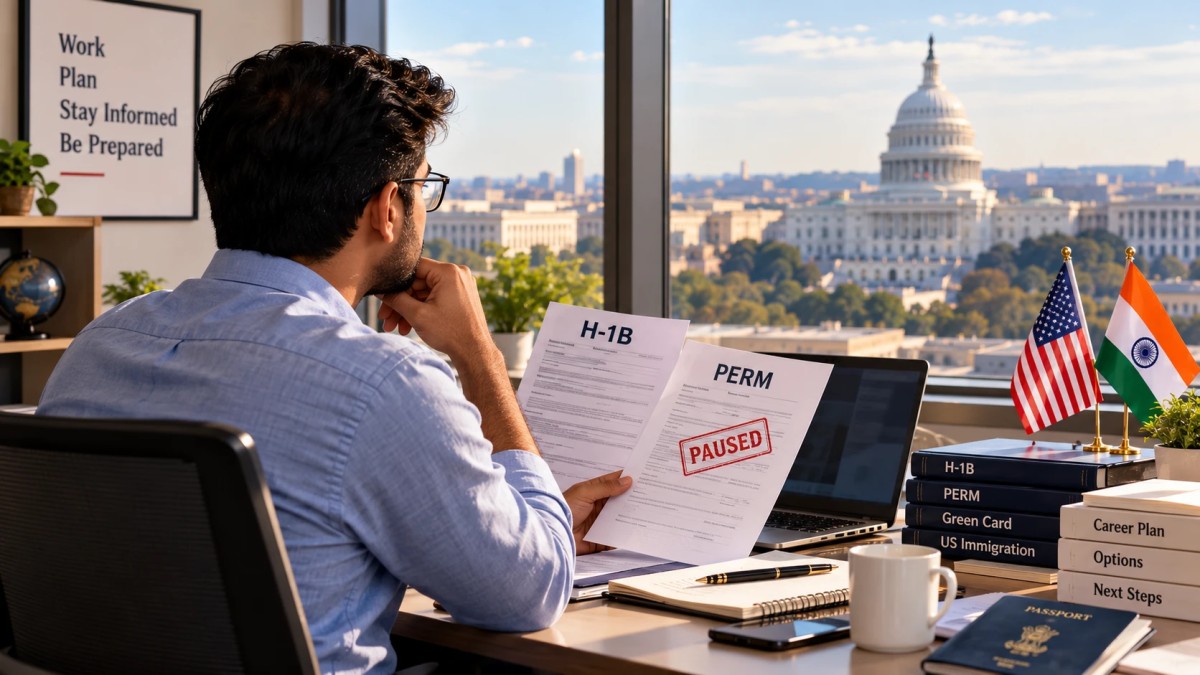
The US government has stopped processing green card applications from eight big employers, four of them Indian IT companies. If you work for Infosys, Tata Consultancy Services (TCS), Wipro, HCL Technologies, Cognizant, Capgemini, Microsoft or Adobe and your green card was at the first step, it's now on hold.
Your H-1B work visa isn't cancelled. But if you're close to the six-year limit on an H-1B, the freeze could matter a lot, and quickly.
Key points
- On 8 October 2026, US Labor Secretary Keith Sonderling said the department would not accept new or process pending PERM labour certifications involving the eight companies.
- PERM is the first step of most employer-sponsored green cards. H-1B visas already granted are not revoked.
- TCS and Infosys say they expect little impact; the Indian IT industry body Nasscom calls the number of affected employees "relatively limited".
- The risk is highest for workers near the H-1B six-year cap whose green card process hasn't reached the stage that allows extensions.
- Separately, on 13 October the Department of Homeland Security proposed ending the policy of giving weight to earlier H-1B approvals when deciding extensions.
What the US announced, and why
The announcement came at a White House event on Thursday, 8 October, with Vice President JD Vance. Sonderling said the Labor Department would no longer accept new permanent labour certification (PERM) applications from the eight companies, or process the ones already pending. Officials cited federal investigations into the companies' use of foreign worker programmes, TIME reported.
Sonderling said the eight companies had sought almost 3 million foreign workers, received more than 230,000 H-1B approvals and obtained over 100,000 permanent labour certifications since 2009. Vance said the suspension would last "as long as it needs to".
There's an odd gap: as of the first reports, the department hadn't published a press release, a Federal Register notice or written guidance. Immigration lawyers expect it to rely on 20 CFR 656.31, a federal rule that lets the department hold applications while it investigates possible fraud or wilful misrepresentation.
The move follows two earlier actions: the department's Inspector General suspended Cognizant's filings in September, and Cloudera's in May 2026. Not all eight are Indian firms. Cognizant is headquartered in New Jersey; Capgemini is French.
How the companies have responded
TCS said its PERM applications were in single digits over the past two years and it doesn't expect the suspension to affect its workforce. It also said it plans to hire 15,000 more people in the US over five years. Infosys said it would cooperate with the Labor Department and doesn't expect a material impact.
Microsoft, which Labor Department data shows was the largest PERM filer through June 2026, said 80% of its H-1B applications last fiscal year were for existing employees, either extensions or changes of status.
Nasscom, the trade body for India's tech industry, said the effect would be limited because relatively few employees seek permanent residency through PERM at these firms.
PERM green card freeze: who is actually affected
The freeze hits people at one specific step. Here's how an employer-sponsored green card usually works:
- PERM labour certification. The employer proves to the Labor Department that it tested the US job market and couldn't find a qualified, willing American worker at the prevailing wage.
- Form I-140. Once PERM is certified, the employer petitions US Citizenship and Immigration Services (USCIS) for the worker.
- Green card. When the worker's "priority date" (their place in the queue) becomes current, they apply to become a permanent resident.
If your case is stuck at step 1, it's frozen. If your I-140 is already approved, your place in the queue is generally protected, because USCIS rules let a worker keep an approved I-140's priority date even after changing employers. The exception: approvals revoked for fraud, wilful misrepresentation, a material error, or because the labour certification itself is invalidated. With federal investigations under way, ask your lawyer whether that exception could come into play.
For Indians, the queue matters more than for almost anyone else. US law caps green cards per country, and India's demand far exceeds its share, so many Indian professionals wait well over a decade for step 3. Indians have also received about seven in ten H-1B approvals in recent years, according to USCIS data.
The H-1B six-year clock: the part that matters most
An H-1B normally lasts a maximum of six years. Two rules from a 2000 law, known as AC21, let workers stay longer while a green card is pending:
- a one-year extension at a time if a PERM or I-140 was filed at least 365 days before the six-year limit; and
- a three-year extension if the I-140 is approved but the worker can't file for the green card because of the per-country cap.
So a worker in year five whose PERM hasn't been filed yet is in the most difficult spot. If their employer can't file PERM, the 365-day window may close, and the six-year limit becomes a hard stop. Immigration lawyers cited by TIME say workers in exactly this position face the greatest risk.
Why it matters: For Indian families in the US, the green card decides whether a parent can change jobs freely, whether a spouse can work, and whether children who grew up in America have to leave at 21. For India, fewer high-earning Indians in the US could mean less money sent home and less angel investment in Indian startups, a point Dinesh Pai of the broking firm Zerodha made to TIME. He also said companies that can't bring talent to the US may move the work to India instead.
What to ask your employer and your lawyer now
This isn't legal advice, and every case is different. These are the questions worth putting to your company's immigration team and, ideally, an independent US immigration attorney:
- Where exactly is my case? Get your PERM case number, filing date and status, and any I-140 receipt or approval notice, in writing.
- How long have I been on H-1B? Count time spent outside the US, which can sometimes be "recaptured" and added back.
- Would a move help? H-1B "portability" lets you start work for a new employer once it files a new H-1B petition. A new employer would have to start PERM again, but an approved I-140 priority date usually travels with you.
- What about my family? H-4 spouses with work permits based on an approved I-140 should check how a job change would affect them.
The wider US crackdown
The PERM freeze isn't the only change. On 13 October, the Department of Homeland Security proposed ending "deference" to earlier approvals, meaning USCIS could re-examine an H-1B extension from scratch even if nothing about the job has changed. It's a proposal, open to public comment, not a final rule.
On 7 October, DHS also proposed a $70,000 fee (about ₹68 lakh at ₹97 to the dollar) for Optional Practical Training, the work period many Indian students use after a US degree. The same week, officials announced investigations into nine US universities over alleged misuse of J-1 exchange visas.
Most of the Indians affected by this didn't choose their employer's compliance record. They chose a job, followed the rules and joined a long queue. What the US does next, and how fast, will decide whether that queue still leads anywhere for them.
Frequently asked questions
What's Your Reaction?
 Like
0
 Dislike
0
 Love
0
 Funny
0
 Wow
0
 Sad
0
 Angry
0





Comments (0)