


Repo rate hike to 5.50% and what it means for your EMI
The RBI raised the repo rate to 5.50% on 7 Oct 2026, its first hike since 2023. What the repo rate is, why it went up, and what it means for EMIs and deposits.

New Delhi (Desk), 17 Oct 2026 (IST) · Explainer
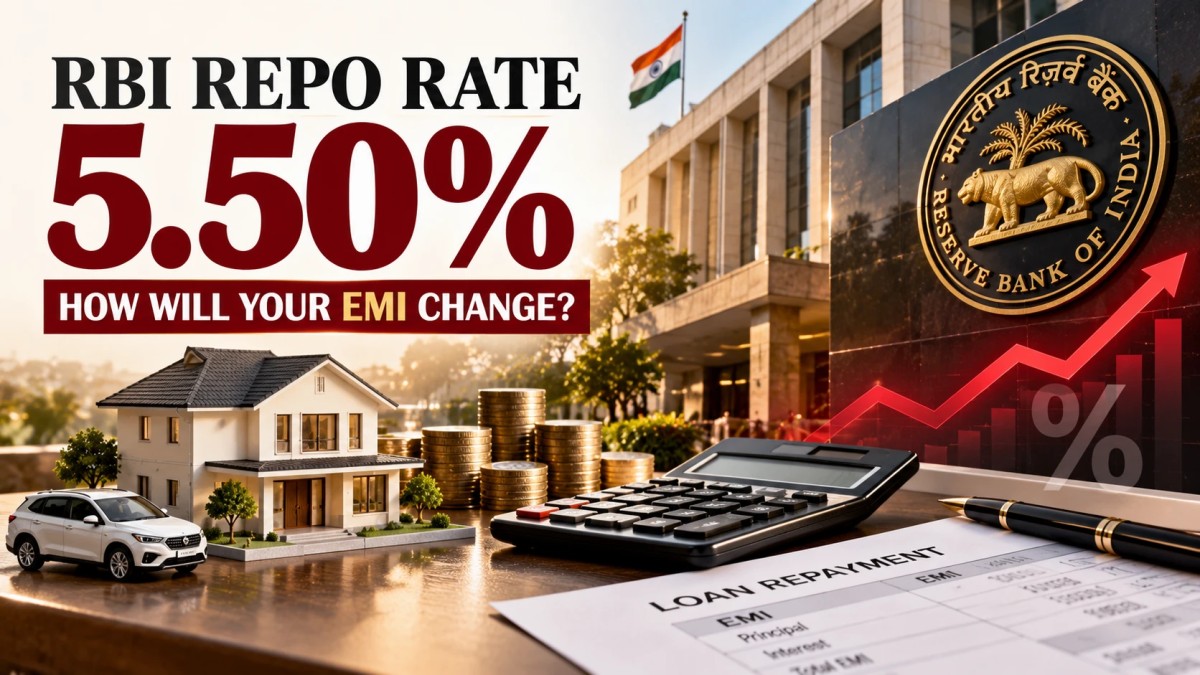
India's central bank has started raising interest rates again. On 7 October 2026, the Reserve Bank of India (RBI) lifted its main policy rate, the repo rate, by 0.25 percentage points to 5.50%, its first increase since February 2023, and said rate cuts are off the table for now.
In short: prices have been rising faster than the RBI wants, partly because of food and crude oil, so it's making borrowing a little more expensive to cool demand. If you have a floating-rate loan, expect your EMI or loan tenure to go up. If you save in fixed deposits, rates may tick up too.
Key points
- Repo rate: up 25 basis points to 5.50%. Standing deposit facility rate: 5.25%. Marginal standing facility and bank rate: 5.75%.
- The policy stance moved from "neutral" to "calibrated tightening": the next move is a hike or a pause, not a cut.
- Retail inflation rose to 5.54% in September, above the RBI's 4% target, with food inflation at 7.74%.
- The RBI raised its growth forecast for 2026-27 to 7.1% and its inflation forecast to 5.2%.
- Next policy decision: 4 December 2026. Minutes of the October meeting: 21 October.
What is the repo rate?
The repo rate is the interest rate at which the RBI lends money to banks for short periods, against government bonds as security. "Repo" is short for repurchase agreement: the bank sells bonds to the RBI and agrees to buy them back later at a slightly higher price. The difference is the interest.
Because it sets the cost of money for banks, it ripples out to almost every loan and deposit in the country. When the repo rate goes up, banks pay more to borrow, and they pass that on.
Two related rates move with it. The standing deposit facility (SDF) rate, now 5.25%, is what the RBI pays banks that park spare cash with it overnight. The marginal standing facility (MSF) rate, now 5.75%, is an emergency borrowing window for banks. Together they form a corridor around the repo rate.
Why did the RBI raise the repo rate?
The short answer is inflation. The Monetary Policy Committee (MPC), the six-member panel that sets the rate, said food and fuel prices were pushing inflation up and that price rises were starting to spread across the economy. It called the outlook "not as benign" as last year and said a recalibration was "imperative", according to the policy statement as reported.
It has three members from the RBI, including the Governor, and three outside experts appointed by the government. Decisions are by majority vote, and the Governor has a casting vote if there's a tie. It normally meets six times a year.
Recent numbers back that up. Retail inflation, measured by the Consumer Price Index (CPI), was 4.8% in August, the figure the MPC had in front of it. September's number, released on 12 October, came in at 5.54%, with food prices up 7.74% and inflation higher in rural areas (6.08%) than in cities (4.88%). Onion prices alone were roughly double a year earlier.
Then there's oil. Brent crude has traded above $100 a barrel, and the MPC listed crude oil volatility, geopolitical tensions, a weak monsoon and El Niño-related weather among the risks. India imports most of its crude, so expensive oil feeds straight into transport and food costs.
The RBI's legal target, set by the government, is 4% CPI inflation, with a tolerance band of 2% to 6%. The MPC now expects inflation to average close to 5.8% over the next three quarters, uncomfortably close to the top of that band.
What does "calibrated tightening" mean?
It's a signal about direction. Under a "neutral" stance, the RBI could move rates up or down. "Calibrated tightening" means it's in a rate-rising phase, but will move in measured steps rather than large jumps.
Governor Sanjay Malhotra made the point plainly: future action can only be a hike or a pause, not a cut, depending on how growth and inflation evolve.
Not everyone on the committee agreed on the stance. Two members, Nagesh Kumar and Ram Singh, wanted to keep it neutral, reports of the resolution say, though the rate hike itself was backed by all six. Some economists expect one more 25 basis point hike in December; others think the cycle could go further. Those are forecasts, not RBI guidance.
How the repo rate hike affects your loans
If you have a floating-rate home, car or personal loan from a bank, it's very likely linked to an external benchmark, usually the repo rate. Since October 2019, the RBI has required banks to link new floating-rate retail loans to such a benchmark, and to reset the rate at least once every three months.
So your bank will probably raise your loan rate by about 0.25 percentage points at the next reset. It may either raise your EMI (equated monthly instalment) or, more commonly, keep the EMI the same and extend the loan's tenure. Ask your bank which it will do; you can usually choose.
Here's a rough example. On a ₹50 lakh (about $51,700) home loan over 20 years, a rise from 8.50% to 8.75% lifts the EMI from about ₹43,390 to about ₹44,190, roughly ₹800 more a month. Over the full term, that adds up to around ₹1.9 lakh (about $1,970) in extra interest if nothing else changes.
Fixed-rate loans don't change. Loans from non-bank lenders may follow their own benchmarks, on their own timetable.
What it means for deposits, the rupee and NRIs
Savers may get a small benefit. Banks often raise fixed deposit rates after a hike, though usually more slowly than they raise loan rates, and not always by the full amount.
For non-resident Indians (NRIs), two things matter. NRE and FCNR deposits, the accounts NRIs use to hold money in India, may see rate increases in the coming weeks if banks reprice. And the rupee: it was trading around ₹96.77 to the US dollar on the day of the decision, according to Forbes India, after falling about 45 paise. A weaker rupee means each dollar, pound or dirham sent home buys more rupees, but it also makes India's imports, including oil, more expensive.
None of this is a reason to move money in a hurry. Rates change slowly, and decisions about deposits or loans depend on your own circumstances.
Why it matters: The repo rate is the most important price in India's economy. For Indian households, it decides how much their loans cost. For readers abroad, it's a sign that India, one of the fastest-growing big economies, is now prioritising inflation control over cheap money, at a time when oil prices and Gulf conflict are pushing costs up worldwide.
The RBI cut rates by a total of 1.25 percentage points in 2025 and then waited. That waiting is over. For most households the change is small, a few hundred rupees a month. The bigger question is whether this is the first of one or two hikes, or the start of a longer climb, and that depends largely on onions, oil and the weather.
This explainer is for information only and is not financial advice.
Frequently asked questions
What's Your Reaction?
 Like
0
 Dislike
0
 Love
0
 Funny
0
 Wow
0
 Sad
0
 Angry
0





Comments (0)