


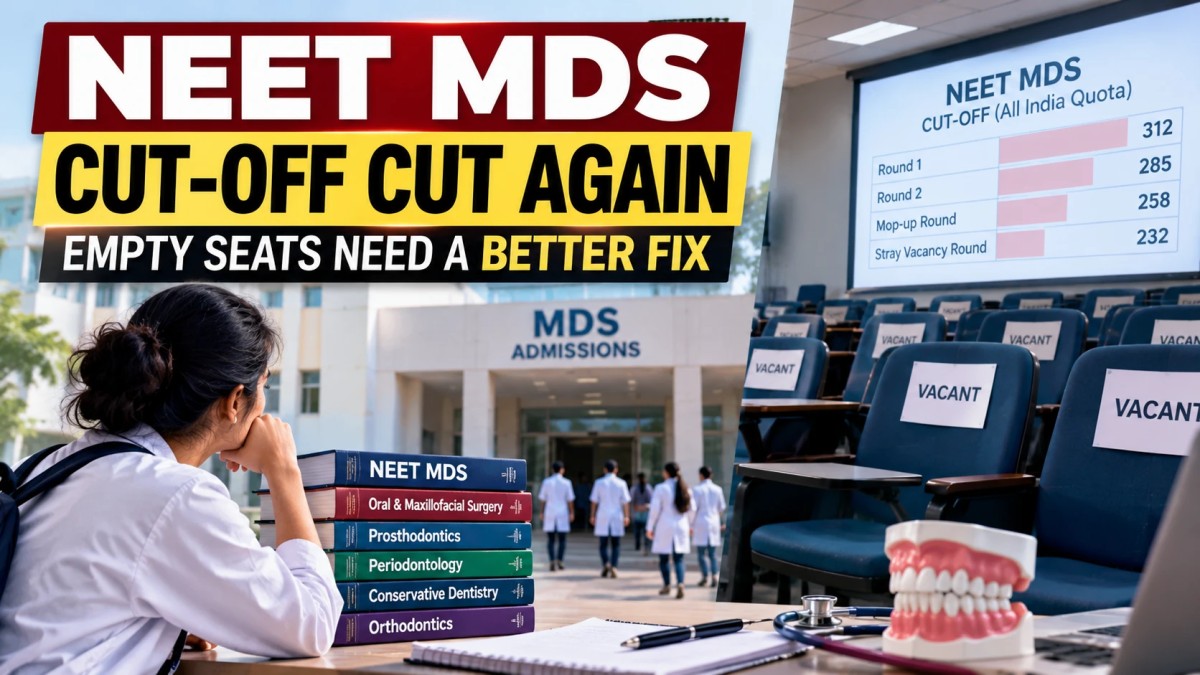
NEET MDS cut-off cut again, empty seats need a better fix
India has cut the NEET MDS qualifying percentile by 20.576 points to fill dental PG seats. Why that misses the real problem, and what would work better.

By Aditya Singh · Opinion
The health ministry has lowered the bar for postgraduate dental admissions, again. On 15 October 2026, the National Board of Examinations in Medical Sciences (NBEMS) published revised cut-offs for NEET MDS 2026, the entrance test for the Master of Dental Surgery degree, after the qualifying percentile was cut by 20.576 points in every category.
Its aim is to fill empty seats. It probably will fill some. But it won't fix why those seats are empty, and doing this year after year is quietly changing what an MDS degree means.
Key points
- The general category qualifying percentile fell from the 50th to the 29.424th, about 234 marks out of 960 instead of 308.
- For SC, ST and OBC candidates it fell from the 40th to the 19.424th percentile (200 marks); for general candidates with disabilities, from the 45th to the 24.424th (218 marks).
- NBEMS says published ranks don't change; more candidates simply become eligible for counselling.
- The reason given in reports is vacant seats, mostly in private dental colleges, after the early counselling rounds.
What changed in the NEET MDS cut-off
NEET MDS is an exam that ranks dentists who already hold a BDS (Bachelor of Dental Surgery) degree for postgraduate seats. The "cut-off" isn't a pass mark in the usual sense. It's a percentile: the minimum position in the ranking a candidate needs to be allowed into counselling at all.
The health ministry communicated the change on 12 October, and NBEMS published the revised scores on 15 October. In the general category, a candidate who sat at the 30th percentile, meaning 70% of candidates scored higher, now qualifies. A month ago, they didn't.
There was reportedly an earlier, smaller cut in late September as well, ahead of the third counselling round. Either way, the direction is the same as in past years, and the same as in medicine, where the NEET PG cut-off was cut to zero percentile in 2023.
The case for lowering the bar
It's worth taking the other side seriously, because it isn't foolish.
Every candidate in this pool is already a qualified dentist. They passed a five-year BDS course, including a year of internship, and they're registered to practise. A percentile in a single competitive test measures how a candidate ranked against others that year, not whether they can learn to be a good orthodontist or oral surgeon.
An empty seat also wastes something real: a teacher's time, clinical equipment and patients who could have been treated by a postgraduate student. And India does need specialists, especially outside the big cities. If lowering the percentile fills seats with BDS graduates who would otherwise not specialise at all, the argument goes, everyone gains.
I accept parts of this.
Why it still misses the point
Here's my problem. Seats aren't empty because too few dentists are allowed to apply. They're empty because many of them, at their current price and quality, aren't worth taking.
Candidates higher up the rankings make a rational choice. Many government college seats fill quickly, because the fees are lower and the training, with heavy patient loads, is usually strong. The seats left over are largely in private colleges, some charging fees that a young dentist can't hope to recover in the early years of practice.
Lowering the qualifying percentile doesn't change any of that. It's also a blunt tool: it applies to every college and every speciality at once, whether a particular seat sits empty because of its fees, its location or the quality of its training. It just widens the pool of people who may accept a seat the top-ranked candidates turned down. The seats get filled by those with the fewest alternatives, or the most money.
That has consequences for patients, eventually. A specialist degree is a promise to the public that the holder was trained to a high standard. Each year we drop entry standards to fill capacity, we lean harder on the training itself to make up the difference, and the colleges with the emptiest seats are not always the ones best placed to do that.
What would actually help
If the problem is that seats are unattractive, fix the seats.
Publish the data. The National Dental Commission, which replaced the Dental Council of India under a 2023 law, should publish, college by college, how many MDS seats went unfilled after each round, the fees charged and the clinical caseload. Students would choose better, and the pattern of empty seats would show where the real problems are.
Enforce stipends and fee rules. Postgraduate students do real clinical work. Where colleges don't pay mandated stipends, or charge fees well above what state committees allow, the regulator should act firmly rather than lowering the bar to help them fill places.
Let some seats lapse. If a college can't fill its seats with candidates above a reasonable bar year after year, that tells the regulator something. Repeatedly empty seats should prompt an inspection and, if needed, a cut in that college's intake, not an annual rescue.
Plan the workforce. India produces a very large number of dental graduates every year, and young dentists' difficulty in finding well-paid work has been a recurring theme in the profession for years. The country would gain more from a clear plan for where specialists are needed, and from public-sector jobs that use them, than from simply producing more MDS degrees.
None of these are quick. That's exactly why the percentile lever is so tempting: it's the one change a ministry can make in a single notice.
What this means for candidates now
For dentists who've just become eligible, the decision is personal, and none of this is advice to stay away. A seat is a seat, and some of the newly available places will be at good colleges.
The practical next step is counselling. The Medical Counselling Committee (MCC), which runs the all-India quota, and state counselling authorities are expected to announce fresh dates for the newly eligible candidates. Keep an eye on their official websites rather than on forwarded messages.
But go in with your eyes open. Check the college's fees and what they include, whether stipends are actually paid, how many patients students see, and what recent graduates are doing now. Talk to current students, not just the admissions office. The cut-off has moved; the cost of a bad choice hasn't.
Why it matters: Dental care is one of the most visible parts of private healthcare in India, and specialists trained today will treat patients for the next 30 years. For readers abroad, including Indian-trained dentists who later move overseas, the standards behind an Indian MDS also affect how the degree is seen elsewhere.
I don't think anyone in the ministry wants weaker specialists. They want full classrooms, and lowering the bar is the fastest way to get them. But a degree's value is set by who earns it and how they're trained. If we keep solving an empty-seat problem with a percentile notice, we shouldn't be surprised when the seat is full and the problem is still there.
Views expressed are the author's own.
Frequently asked questions
What's Your Reaction?
 Like
0
 Dislike
0
 Love
0
 Funny
0
 Wow
0
 Sad
0
 Angry
0





Comments (0)