


How India's Union Budget works, a plain-English guide
India's Union Budget sets ₹53.5 lakh crore of spending for 2026-27. What the fiscal deficit, capex and Finance Bill mean, and how Parliament passes a Budget.

New Delhi (Desk), 18 Oct 2026 (IST) · Explainer
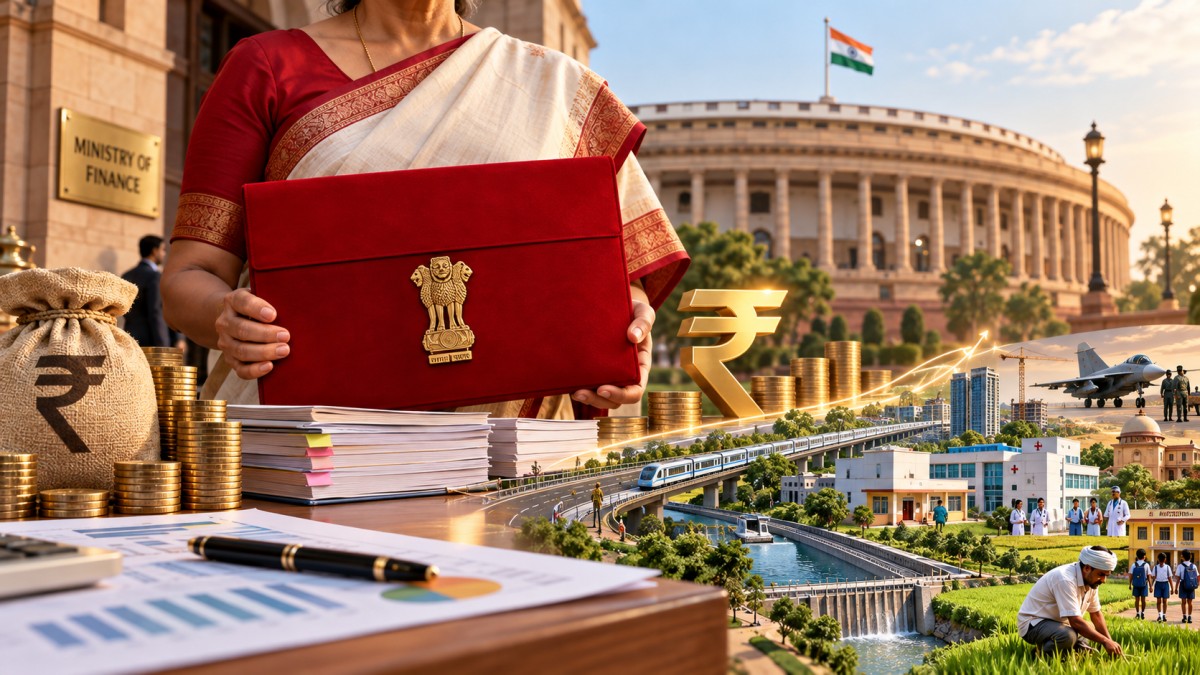
Every year on 1 February, India's Finance Minister stands up in the Lok Sabha and presents the Union Budget: the central government's plan for how much it will earn, spend and borrow in the year from 1 April. The 2026-27 Budget, presented by Nirmala Sitharaman on 1 February 2026, set total spending at about ₹53.5 lakh crore.
This guide explains the main terms, how the Budget is made and passed, and why markets, states and taxpayers all watch it so closely.
Key points
- The Budget is called the "Annual Financial Statement" in the Constitution (Article 112).
- 2026-27: spending of about ₹53.5 lakh crore, a fiscal deficit target of 4.3% of GDP and capital spending of about ₹12.2 lakh crore.
- Tax changes are made through the Finance Bill; spending through the Appropriation Bill.
- The Budget must be passed by the Lok Sabha; the Rajya Sabha can only suggest changes to money bills.
- The next Budget is due on 1 February 2027.
How the Union Budget works
The Budget has two sides:
- Receipts: money coming in, from taxes such as income tax, corporate tax and the Centre's share of GST, and from non-tax sources such as dividends from public sector companies and the Reserve Bank, plus borrowing.
- Expenditure: money going out, from salaries, pensions, interest and subsidies to roads, railways and defence.
Each side is split into revenue and capital. Revenue spending covers running costs that don't create assets, like salaries and interest. Capital spending creates assets, like highways or new railway lines, or reduces liabilities.
The numbers that matter
| Term | What it means | 2026-27 Budget |
|---|---|---|
| Total expenditure | Everything the Centre plans to spend | About ₹53.5 lakh crore |
| Capital expenditure (capex) | Spending on assets such as roads and railways | About ₹12.2 lakh crore |
| Fiscal deficit | Total spending minus receipts other than borrowing | 4.3% of GDP |
| Revenue deficit | Revenue spending minus revenue receipts | 1.5% of GDP |
| Debt-to-GDP | Central government debt as a share of the economy | 55.6% |
Figures as reported by Upstox, Paytm Money and other budget summaries; the revised estimate for 2025-26 put the fiscal deficit at 4.4% and spending at about ₹49.6 lakh crore.
The fiscal deficit is the number economists watch most. It shows how much the government must borrow to cover the gap. A lower deficit leaves more room for private companies to borrow and helps keep interest rates in check. The government has said it will now target a falling debt-to-GDP ratio rather than a fixed deficit number.
How a Budget is made
Work starts months earlier. In about September or October, the Finance Ministry's Department of Economic Affairs asks every ministry for its spending estimates. Officials then hold pre-Budget meetings with industry groups, economists, farmers' groups and state finance ministers.
In the final weeks, officials working on the Budget documents are kept inside the ministry's North Block offices until the speech, a tradition marked by the halwa ceremony in which halwa is served to the staff before the lock-in begins. The Economic Survey, a report on the state of the economy by the Chief Economic Adviser, is usually tabled a day or two before the Budget.
Until 2017, the Budget was presented on the last working day of February, and the Railway Budget was separate. Both changed in 2017: the date moved to 1 February so that spending could start on 1 April, and the Railway Budget was merged into the Union Budget.
How Parliament passes the Budget
After the speech, Parliament does three things:
- General discussion of the Budget in both houses.
- Committee scrutiny. Parliament usually takes a recess while standing committees examine each ministry's demands for grants.
- Voting. The Lok Sabha votes on the demands for grants, then passes the Appropriation Bill, which allows money to be withdrawn from the Consolidated Fund of India, and the Finance Bill, which contains the tax changes.
Both are money bills. The Rajya Sabha can recommend changes within 14 days, but the Lok Sabha can accept or reject them. Because the process takes time, Parliament often passes a vote on account to allow spending in the first months of the year, especially in an election year, when an interim Budget is presented.
Why it matters: The Budget decides how much tax you pay, how much the government spends on infrastructure, defence, health and welfare, and how much it borrows. Markets react to the fiscal deficit and to tax changes on capital gains. Global investors and ratings agencies read it as a test of India's fiscal discipline, and NRIs watch it for changes to tax on income earned in India.
What to watch on Budget day
- Income tax slabs and rates for individuals, and any change in capital gains tax.
- The fiscal deficit target for the coming year and the revised figure for the current one.
- Capex, the main driver of public investment.
- Big schemes, such as housing, rural jobs and food subsidies.
- Borrowing, which affects bond yields and, through them, loan rates.
Where the money comes from and where it goes
Each Budget includes a simple chart showing where every rupee comes from and where it goes. In recent Budgets, borrowing and other liabilities have been the largest single source of money, ahead of GST, income tax and corporate tax. On the spending side, interest payments on past borrowing have been the largest single item, followed by the states' share of taxes, central schemes and defence.
States' share: the Centre collects most big taxes but shares a fixed part of the divisible pool with states, as recommended by the Finance Commission. In recent years that share has been 41%. Cesses and surcharges are not shared, which is a frequent source of complaint from states.
A short glossary
- Gross tax revenue: all taxes the Centre collects, before passing on the states' share.
- Non-tax revenue: dividends from public companies and the RBI, fees and interest received.
- Disinvestment: money raised by selling stakes in public sector companies, such as the IDBI Bank sale approved in October 2026.
- Primary deficit: the fiscal deficit minus interest payments; it shows whether the government is borrowing to pay past interest or for new spending.
- Revised estimate: an updated figure for the current year, presented with the next Budget.
What the Budget means for your money
For most salaried taxpayers, the most important part of the speech is the income tax section. Changes announced in a February Budget usually apply from 1 April, so check how your employer's tax deductions change from the April salary. The new tax regime has been the default since 2023-24, and recent Budgets have focused their relief on it.
India's new Income-tax Act, 2025, replaced the 1961 Act from 1 April 2026, so Budget changes now amend the new law. For NRIs, the Budget can change tax on interest, property sales and capital gains in India, and the rules on residency.
A Budget is ultimately a statement of priorities in numbers. Reading three of them, the deficit, the capex figure and the tax changes, tells you most of what you need to know about where the government is heading.
This article is general information, not investment or tax advice.
Frequently asked questions
What's Your Reaction?
 Like
0
 Dislike
0
 Love
0
 Funny
0
 Wow
0
 Sad
0
 Angry
0






Comments (0)