


 National
Disability pension now at 40% disability, ₹375 a month
India's Cabinet renamed the NSAP pension scheme and cut the disability bar from 80% to 40%, with ₹375 a month for most. Who gains, and what stays the same.

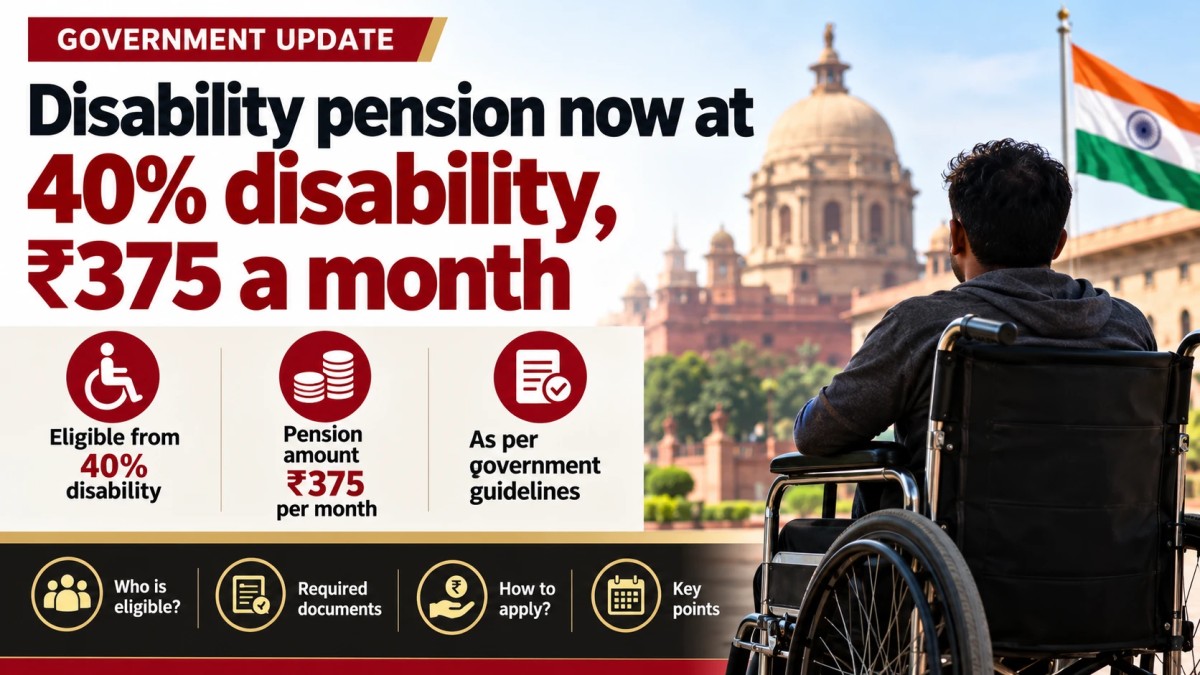
India's main pension scheme for poor households has a new name, and a big change for disabled people. The Union Cabinet decided on 14 October 2026 that a disability pension will now go to anyone with a disability of 40% or more, down from 80%, and from birth instead of from age 18.
Payments go up too: ₹375 a month for anyone up to 79 years old and ₹625 for those 80 and above. That's roughly $3.90 and $6.45. Old-age and widow pensions keep their current amounts.
Key points
- The National Social Assistance Programme (NSAP) is now the Pradhan Mantri Samajik Sahayata Yojana, with ₹53,428 crore (about $5.5 billion) set aside for five years, 2026-27 to 2030-31.
- Disability pension: eligibility cut from 80% disability to 40%, no minimum age, and ₹375 or ₹625 a month.
- Old-age, widow and family benefit schemes continue unchanged apart from their names.
- About 3.2 crore (32 million) people in all 36 states and union territories are covered, according to the government.
- New guidelines are due within three months, so the changes are not yet in force.
What the Cabinet decided on 14 October
The Cabinet, chaired by Prime Minister Narendra Modi, approved a five-year extension of the NSAP with an outlay of ₹53,428 crore, according to the Press Information Bureau (PIB), the government's official news agency. The decision came in three parts: new names for the scheme and its sub-schemes, a wider and better-paid disability pension, and no change to the other pensions.
Information and Broadcasting Minister Ashwini Vaishnaw briefed reporters after the meeting, All India Radio reported. The proposal came from the Department of Rural Development, which runs the programme.
The ₹53,428 crore is a total for five years, not a yearly budget. Spread evenly, it works out to a little over ₹10,000 crore a year.
The new names, scheme by scheme
Every part of the programme gets a "Pradhan Mantri" (Prime Minister's) name, the prefix used for most central government schemes. Three of the old names honoured former Prime Minister Indira Gandhi.
| Old name | New name |
|---|---|
| National Social Assistance Programme | Pradhan Mantri Samajik Sahayata Yojana |
| Indira Gandhi National Old Age Pension Scheme | Pradhan Mantri Vridhavastha Pension Yojana |
| Indira Gandhi National Widow Pension Scheme | Pradhan Mantri Vidhawa Pension Yojana |
| Indira Gandhi National Disability Pension Scheme | Pradhan Mantri Divyangjan Pension Yojana |
| National Family Benefit Scheme | Pradhan Mantri Parivar Labh Yojana |
"Yojana" means scheme. "Divyangjan" is the official Hindi term the government uses for persons with disabilities.
Disability pension at 40%: who now qualifies
The biggest change is the disability threshold. Until now, the central disability pension went only to people in poor households with 80% disability or more, which in practice meant severe or multiple disabilities. From the new guidelines onwards, the bar is 40%.
That number isn't random. India's Rights of Persons with Disabilities Act, 2016 defines "benchmark disability" as 40% or more of a specified disability, and most disability benefits, from job quotas to college seats, already use it. The pension scheme was the odd one out. PIB said the 2016 law "necessitated" the change.
The second change matters for families. The minimum age is gone, so a child born with a disability in a poor household can get the pension. Earlier, the scheme started at 18.
How many more people will qualify isn't yet clear. The government's 3.2 crore figure covers all five schemes together, and the PIB release doesn't say how many new disability pensioners it expects. For scale, the 2011 Census counted about 2.68 crore people with disabilities, a little over 2% of the population, though not all of them are poor or meet the 40% test.
How much money people will get
The disability pension rises to ₹375 a month for people up to 79 and ₹625 for those 80 and older. Under the old NSAP rates, a disability pensioner got ₹300 a month (₹500 at 80 and above), so this is a 25% rise.
That figure comes straight from the law too. The 2016 Act says disability-related assistance should be at least 25% higher than similar schemes for other groups, and PIB cited that rule.
Old-age and widow pensions don't change. Under the current NSAP guidelines, the central share is ₹200 a month for people aged 60 to 79 and ₹500 for those 80 and older; the widow pension is ₹300 a month (₹500 from 80). The family benefit scheme pays a one-time ₹20,000 when a poor household loses its main earner aged 18 to 59.
These are only the central government's contribution. Most states add their own money, which is why a pensioner in one state can receive several times what someone gets in another. The Centre pays 100% of its share, which PIB says is meant to keep the basic amount the same everywhere.
When the changes start
Not yet. PIB says guidelines on the new eligibility rules, the number of beneficiaries and the new disability rates "will be issued and implemented within three months". That points to around mid-January 2027.
Until then, existing pensioners keep getting paid as before. People who expect to qualify under the 40% rule will need a disability certificate (most now have a Unique Disability ID card, or UDID, issued by state medical boards) and proof that the household meets the scheme's poverty criteria. Applications go through the state social welfare department or the local panchayat (village council) or municipal office, depending on the state.
Why it matters: For India, this is one of the largest cash support programmes for the poorest elderly, widowed and disabled people, and the disability change could add many families who've been shut out since 1995. For readers abroad, think of it as India's basic safety-net pension: small sums by global standards, paid to tens of millions of people, and a test of how far the Centre will go in raising amounts that have barely moved in years.
The bigger picture: a scheme from 1995
The NSAP was launched on 15 August 1995. It rests on Article 41 of the Constitution, one of the Directive Principles of State Policy, which asks the state to provide public help in old age, sickness and disability, within its means.
The central rates were last revised in 2012, and evaluations of the scheme have noted that they haven't kept pace with inflation. At about $2, ₹200 a month for a 65-year-old doesn't stretch far, and this decision leaves that rate where it is. Only the disability pension goes up.
So the case for this decision rests on reach rather than on money. A lower disability bar and no age floor mean the scheme can now cover children and working-age adults who, under the old rules, simply weren't eligible however poor their families were.
There's also a practical reason the 40% line matters. Disability certificates in India already state a percentage, and most other benefits kick in at 40%. Someone certified at 60% has, until now, been able to claim a reserved government job or college seat but not the monthly pension. That mismatch is what the Cabinet has closed.
The money is small. But for a mother in a village whose child was born with cerebral palsy, the difference between "not eligible until 18, and only at 80%" and "eligible now" is real. Whether it reaches her depends less on Delhi's announcement than on how quickly states issue certificates and process forms over the next three months.
Frequently asked questions
What's Your Reaction?
 Like
0
 Dislike
0
 Love
0
 Funny
0
 Wow
0
 Sad
0
 Angry
0






Comments (0)