


 Schengen & EU Visas
Explainer
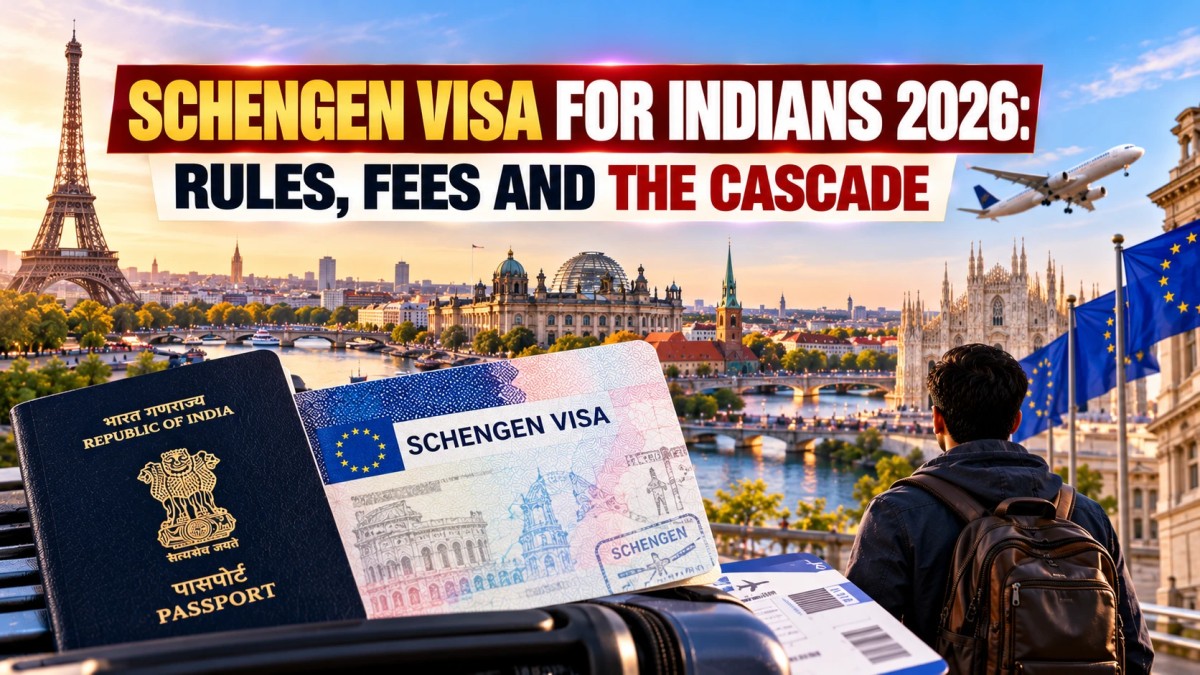
Schengen visa for Indians in 2026, rules, fees and cascade
How Indians apply for a Schengen visa in 2026: which country, the €90 fee, the 90/180-day rule, the cascade route to a five-year visa, and the new EES.

New Delhi (Desk), 18 Oct 2026 (IST) · Explainer
Indian passport holders need a Schengen visa for short trips, of up to 90 days in any 180-day period, to the 29 European countries in the Schengen area, from France and Germany to Switzerland and Greece. One visa covers all of them.
The process is more predictable than it used to be. Since 2024, the EU has applied a "cascade" for Indian travellers: people with a good visa history can step up to a two-year and then a five-year multiple-entry visa. And from 2026, a new digital border system, the Entry/Exit System (EES), records every entry and exit.
Key points
- A Schengen short-stay visa allows up to 90 days in any rolling 180-day period across the Schengen area.
- Apply to the country of your main destination; if there's no main one, the country of first entry.
- The standard visa fee is €90 for adults and €45 for children aged 6 to 12.
- Under the cascade for Indians, people who've used previous visas lawfully can get two-year, then five-year, multiple-entry visas, at the consulate's discretion.
- The EU's Entry/Exit System records fingerprints and a photo at the border; it doesn't replace the visa.
What a Schengen visa covers
The Schengen area is a group of European countries that have removed passport checks at their shared borders. It includes most EU countries plus Iceland, Liechtenstein, Norway and Switzerland. Bulgaria and Romania became full members in 2025. Ireland, which keeps its own visa rules, and Cyprus are not part of it.
A Schengen short-stay visa (type "C") is for tourism, business meetings, visiting family, attending conferences or short courses. It does not let you work. For study, work or long stays, you need a national long-stay visa from the specific country.
The 90/180-day rule
This is the rule most travellers get wrong. You can spend up to 90 days in any 180-day period in the Schengen area. The 180 days aren't a calendar period; they're a rolling window counted back from each day you're there.
So if you spent 60 days in Europe in spring, you can't simply return in summer for another 90. On any day of your stay, look back 180 days: the total number of days you've been in Schengen in that window must not exceed 90. The European Commission publishes a short-stay calculator online that does this for you.
Overstaying, even by a few days, can lead to fines, an entry ban and problems getting future visas.
Schengen visa for Indians: the cascade rule
In April 2024, the EU adopted a specific "cascade" for Indian nationals under the EU Visa Code, to give frequent, lawful travellers longer visas. In outline:
- After two Schengen visas obtained and used lawfully within the previous three years, an applicant can be issued a two-year multiple-entry visa.
- After that, a five-year multiple-entry visa can follow, if the applicant's passport is valid long enough.
Two points matter. First, it's not automatic: consulates still assess every application and can refuse or issue a shorter visa. Second, some visa types, such as airport transit visas and visas with limited territorial validity, don't count towards your history.
A multiple-entry visa still follows the 90/180-day rule. It doesn't allow longer stays; it saves you from reapplying for every trip.
How to apply
- Pick the right country. Apply to the embassy or consulate of the country where you'll spend the most time. If your time is equal, apply to the country you'll enter first.
- Book an appointment at the official visa application centre the country uses. Many member states outsource appointments to private visa centres in Indian cities. Apply up to six months before travel, and at least 15 days before.
- Prepare documents: a passport issued within the last ten years and valid for at least three months after your trip, with two blank pages; a completed form; photos; travel insurance covering at least €30,000 of medical costs across Schengen; proof of accommodation and travel plans; proof of funds (usually bank statements); and, for employees, a letter from your employer.
- Give biometrics (fingerprints and a photo) at the appointment, unless you've done so in the past 59 months.
- Pay the fee: €90 for adults, €45 for children aged 6 to 12, plus the visa centre's service charge.
Decisions usually take about 15 days, but can take longer in peak season.
Why it matters: Europe is one of the fastest-growing destinations for Indian tourists and business travellers, and a key market for Indian students and professionals. For families, getting a five-year visa can turn Europe from a once-in-a-lifetime trip into a regular one. For European countries, Indian visitors are among the biggest spenders from outside the EU.
The Entry/Exit System and ETIAS
The Entry/Exit System (EES) replaces passport stamps with a digital record. At your first entry, border officers collect your fingerprints and a facial image, and the system logs every entry and exit after that. It was rolled out in phases from October 2025 and reported fully operational at Schengen external borders from 10 April 2026. Expect longer queues at your first entry, and allow extra time for connections at big hub airports such as Frankfurt, Paris or Amsterdam.
ETIAS, the European Travel Information and Authorisation System, is a separate online travel authorisation, but it's only for travellers from visa-free countries, such as the US or UK. Indian passport holders still need a visa, so ETIAS doesn't apply to them. Indians who hold another country's passport, such as a British or US citizen of Indian origin, would use ETIAS once it starts.
Visiting family or travelling for business
If you're visiting relatives or friends who live in Europe, consulates usually want an invitation letter, a copy of your host's residence permit or passport, and their address. Some countries use a formal sponsorship document: in Germany, for example, a host can sign a Verpflichtungserklärung, a formal declaration of financial responsibility, at their local foreigners' office.
Business travellers usually need an invitation from the European company, a letter from their Indian employer explaining the purpose, and proof of who's paying. Each country also sets its own expectation of how much money a traveller should have per day; check the specific embassy's checklist rather than a generic list online.
Common reasons for refusal
Refusal letters often cite the same issues: doubts about your intention to return to India, insufficient funds, a vague itinerary, inconsistent documents, or insurance that doesn't meet the rules. Applying to the wrong country, often to get a quicker appointment, can also lead to refusal.
If you're refused, the letter explains the reasons and how to appeal, which differs by country. Fix the specific problem before reapplying, and be honest about the earlier refusal: forms ask about previous refusals, and hiding one is a far bigger problem than the refusal itself.
The best Schengen application is the boring one: the right country, the exact documents, a clear itinerary and an honest return plan. Do that twice, use the visas lawfully, and the five-year visa that once seemed rare becomes a realistic next step.
This explainer is general information, not legal advice.
Frequently asked questions
What's Your Reaction?
 Like
0
 Dislike
0
 Love
0
 Funny
0
 Wow
0
 Sad
0
 Angry
0




Comments (0)