


 Society
Nagaland spurious liquor deaths rise to 23; probe sought
Suspected spurious liquor has killed 23 people in Nagaland's Mokokchung and Tuensang since September. Groups want a probe and a review of the prohibition law.

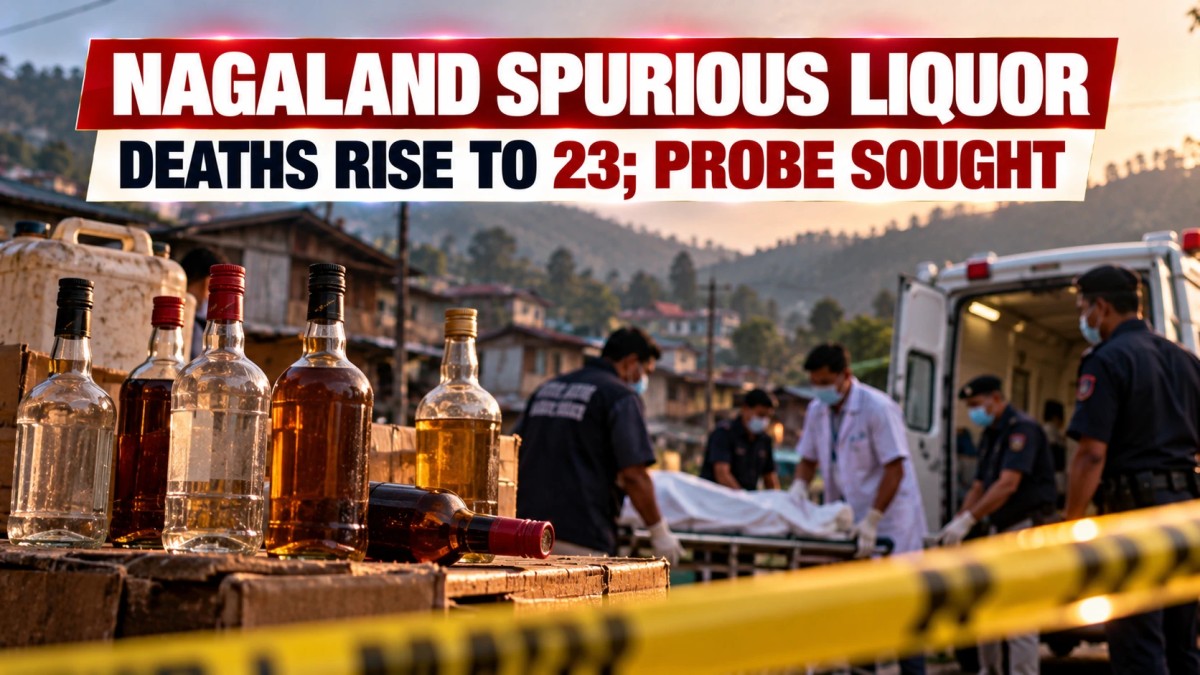
The number of people who have died after allegedly drinking spurious liquor in Nagaland's Mokokchung and Tuensang districts has risen to 23, according to reports, after three more deaths at Longphayimsen village in Mokokchung on 15 and 16 October 2026. Methanol poisoning is suspected, though forensic confirmation is still awaited.
Nagaland has been a "dry" state since 1989, when its Liquor Total Prohibition Act banned the sale and consumption of alcohol. The deaths have revived a long debate about whether prohibition is working.
Key points
- Reported toll: 23 deaths since late September in Mokokchung and Tuensang; the real number could be higher, local groups say.
- The three latest deaths, on 15 and 16 October, were of agricultural workers from Assam, according to police cited by UNI.
- A Special Investigation Team was set up after the first deaths in September; 19 people were arrested and nearly 3,000 bottles seized, reports said.
- The National People's Party and the Mokokchung Town Lanur Telongjem want a transparent, time-bound probe and an evidence-based review of the prohibition law.
What has happened so far
The first deaths were reported in late September: eight in Mokokchung district and 11 in Tuensang, The Week reported at the time. Police said methanol had been found in seized illicit liquor, though laboratory tests couldn't establish how much.
A Special Investigation Team (SIT) was formed to trace the source, and police carried out raids, arrested 19 people and seized nearly 3,000 bottles of liquor, PTC News reported. Samples were sent to Guwahati for forensic testing.
The latest three deaths, at Longphayimsen under Longtho police station, were reported on 15 and 16 October, Eastern Mirror and UNI reported. The victims were agricultural workers from Assam, police said.
Nagaland spurious liquor deaths: the demands
The National People's Party (NPP) has asked for a comprehensive, transparent and time-bound investigation, coordination with Assam's enforcement agencies to trace suppliers, legal action based on forensic findings, relief for bereaved families and public awareness campaigns, Eastern Mirror reported. It questioned how dangerous liquor could be made, moved and sold despite prohibition.
The Mokokchung Town Lanur Telongjem (MTLT), a civil society body, has called for a "comprehensive review" of the Nagaland Liquor Total Prohibition (NLTP) Act, 1989, and an evidence-based debate in the Assembly, but not repeal. It also asked police to explain the status of a probe into 15,824 empty rum bottles seized at Sewak Gate in May 2026, and warned against blaming the government, the church or civil society alone.
The district administration and police have said they follow a "zero-tolerance approach towards illegal alcohol", Eastern Mirror reported.
Why it matters: Methanol poisoning from illicit liquor has killed thousands of people in India over the years, often in states with partial or full prohibition, where an unregulated black market fills the gap. For readers abroad, Nagaland's debate is a familiar one in many countries: whether a ban protects people or pushes them towards more dangerous products.
What prohibition looks like in Nagaland
The NLTP Act was passed in 1989 after campaigns led largely by church groups, and it bans the sale and consumption of alcohol across the state. Critics say it has created a large illegal trade, with liquor brought in from neighbouring states. Supporters say lifting it would worsen alcohol-related harm in a state where the church plays a central role in public life.
The state government hasn't announced any change to the law, and we found no report of an official statement on a review by 18 October.
Twenty-three deaths in a few weeks, in two districts, is a public health emergency as much as a crime story. Whatever the Assembly decides about prohibition, the immediate question is simpler: where is the poison coming from, and who's selling it?
Frequently asked questions
What's Your Reaction?
 Like
0
 Dislike
0
 Love
0
 Funny
0
 Wow
0
 Sad
0
 Angry
0





Comments (0)