


OCI card rules 2026, who qualifies and what changed
What the OCI card is, who qualifies, what it allows in India, and the 2026 changes: online forms, e-OCI, no six-month wait, a fine for late passport updates.

New Delhi (Desk), 18 Oct 2026 (IST) · Explainer
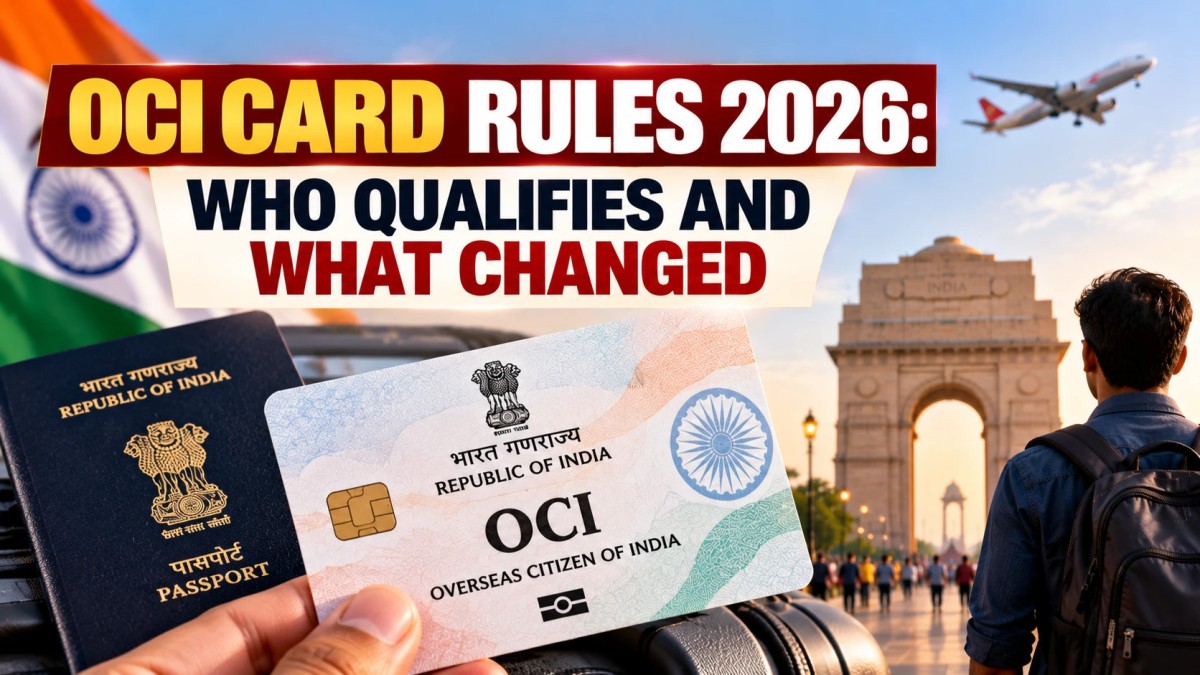
An OCI card, short for Overseas Citizen of India, is a lifelong, multiple-entry visa to India for people of Indian origin who hold another country's passport, and for some of their spouses. It isn't citizenship: OCI holders can't vote, stand for election or hold certain public posts. But it lets millions of people in the diaspora live, work and study in India without applying for a visa each time.
In 2026 the rules changed in several ways. Applications are now online-only, an electronic e-OCI is available, the six-month stay requirement for some applicants has gone, and there's a fine for not updating passport details on time.
Key points
- OCI is a lifelong, multi-purpose visa for foreign nationals of Indian origin and eligible spouses; it's not dual citizenship.
- Since 1 April 2026, applications are online, and postal submission to Indian missions has ended.
- An e-OCI is now available; the physical card is optional.
- From 8 April 2026, eligible foreign nationals in India don't need six months' stay before applying.
- A USD 25 fine applies if you don't update new passport details on the OCI portal within three months.
What is an OCI card?
India doesn't allow dual citizenship. When an Indian citizen takes another nationality, they lose their Indian citizenship. The OCI scheme, created in 2005 under Section 7A of the Citizenship Act, is India's answer for that diaspora.
An OCI holder gets a lifelong, multiple-entry visa for any purpose, whether a holiday, a job, a business or study, and is exempt from registering with police during stays in India. OCI holders also get the same treatment as non-resident Indians (NRIs) in many economic, financial and educational matters, though not all.
The document comes as an OCI card (a booklet that sits with your foreign passport) or, from 2026, an electronic e-OCI.
OCI replaced an older scheme. Until 2015, many people of Indian origin held a PIO (Person of Indian Origin) card, which gave fewer benefits. In January 2015 the government merged the two, and PIO cardholders were asked to convert to OCI. If an older relative still travels on a PIO card, check its current validity on the OCI portal before they fly.
Who qualifies for OCI?
Broadly, a foreign national can apply if they:
- were a citizen of India on or after 26 January 1950, or were eligible to be one on that date; or
- belong to a territory that became part of India after 15 August 1947; or
- are a child, grandchild or great-grandchild of such a person; or
- are a minor child of such a person, or of an Indian citizen; or
- are the foreign spouse of an Indian citizen or of an OCI holder, if the marriage has been registered and has lasted at least two years.
There's a firm exclusion: a person isn't eligible if they, or a parent, grandparent or great-grandparent, have ever been a citizen of Pakistan or Bangladesh, or of other countries the central government specifies. Serving or retired members of foreign armed forces are also generally excluded.
In 2026, eligibility widened in one specific case: fifth- and sixth-generation Indian-origin Tamils in Sri Lanka can now apply, where earlier it stopped at the fourth generation, according to the immigration law firm Fragomen.
OCI card rules 2026: what changed this year
The Ministry of Home Affairs notified amendments to the Citizenship Rules in April 2026. The main changes reported so far:
Online-only applications. Since 1 April 2026, OCI applications are made online, and postal submission to Indian embassies and consulates has stopped. Documents that must be shown physically now have to be presented in person.
e-OCI. Applicants can choose an electronic OCI document, and the physical card is now optional, Fragomen reported in May 2026. The change is linked to biometric "e-gate" processing at Indian airports, which matches passport and OCI data in real time.
No six-month wait in India. From 8 April 2026, the Bureau of Immigration clarified that eligible foreign nationals already in India on a valid long-term visa can apply for OCI without first completing six months' stay.
A fine for late passport updates. If you get a new foreign passport, you must upload its details on the OCI portal within three months. Miss that, and there's a USD 25 fine (or the local equivalent).
Minors and two passports. Reports of the 2026 rules say minors won't be allowed to hold an Indian passport and a foreign passport at the same time. Check the notification on the OCI portal if this affects your family.
Cancellation for serious crimes. Separately, since August 2025, OCI registration can be cancelled if the holder is convicted of serious criminal offences, under rules the home ministry tightened then.
What an OCI holder can and can't do
Can: enter India any number of times and stay as long as they like; work in the private sector; study; open bank accounts and invest under NRI-style rules in most cases; buy residential and commercial property; adopt children from India on the same footing as NRIs.
Can't: vote; stand for election; hold constitutional posts such as President, Vice-President or judge of the Supreme Court or a High Court; normally take government jobs; or buy agricultural land, farmhouses or plantations.
Needs special permission: research, missionary or tabligh (religious preaching) work, mountaineering, journalism, and visits to protected or restricted areas, such as parts of the North-East and border regions. These rules were tightened in a 2021 notification.
Why it matters: Millions of people of Indian origin, in the US, UK, Canada, Australia, the Gulf, the Caribbean and beyond, rely on OCI to visit family, own homes or work in India. For India, the scheme is a bridge to one of the world's largest and most influential diasporas. For any family where children are born abroad, getting OCI right is the difference between a smooth trip home and a visa queue.
How to apply, step by step
- Go to the official portal: ociservices.gov.in. Avoid agents and lookalike sites that charge extra; the government portal's address ends in .gov.in.
- Fill in the online form and upload a photo, signature and documents: proof of Indian origin (for example, a parent's or your own old Indian passport), your current foreign passport, and proof of renunciation or surrender of Indian citizenship if you held it.
- Pay the fee online. Fees differ for applications made abroad and in India; check the portal for the current amount.
- Present documents in person where required, at the mission or the Foreigners Regional Registration Office (FRRO) in India.
- Choose e-OCI or a physical card, then track the application on the portal.
When you get a new foreign passport later, upload it on the portal within three months to avoid the fine.
The OCI card is one of those documents people think about only when something goes wrong, usually at an airport counter at 2 AM. The 2026 changes make most of it easier. The one new trap is the three-month passport update. Set a reminder on your phone the day your new passport arrives.
This explainer is general information, not legal advice.
Frequently asked questions
What's Your Reaction?
 Like
0
 Dislike
0
 Love
0
 Funny
0
 Wow
0
 Sad
0
 Angry
0





Comments (0)