


NRE vs NRO vs FCNR, which NRI account does what
NRE, NRO and FCNR accounts explained for non-resident Indians: what money goes where, what's taxed, what you can send abroad, and the USD 1 million NRO limit.

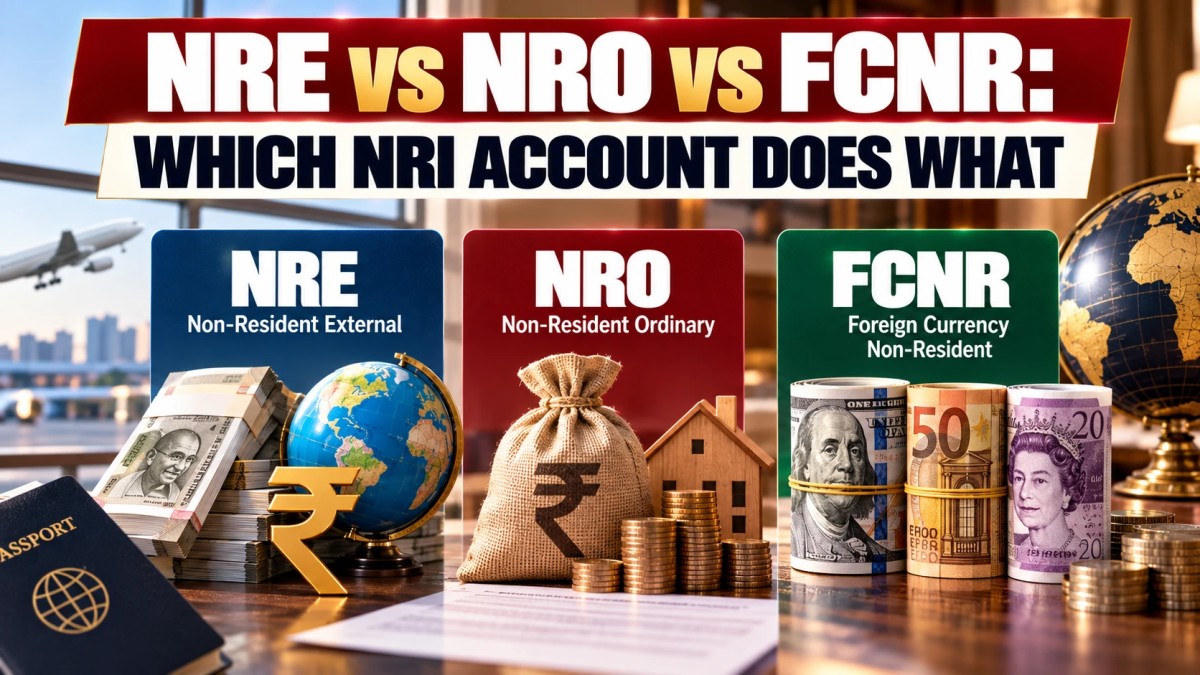
New Delhi (Desk), 18 Oct 2026 (IST) · Explainer
If you're an Indian living abroad, you'll usually need one of three kinds of bank account in India: NRE for money you earn abroad, NRO for money you earn in India, and FCNR for deposits you want to keep in a foreign currency. The difference matters because each one is taxed differently and has different rules on sending money back out of India.
The short version: NRE money is tax-free in India and freely sent abroad; NRO money is taxed in India and capped at USD 1 million a year when you send it abroad; FCNR deposits stay in dollars, pounds or other currencies, so you avoid rupee risk.
Key points
- NRE (Non-Resident External): holds foreign earnings in rupees. Interest is exempt from Indian income tax; principal and interest can be sent abroad freely.
- NRO (Non-Resident Ordinary): holds income earned in India, such as rent, pension or dividends. Interest is taxable in India; repatriation is capped at USD 1 million per financial year, after tax.
- FCNR(B) (Foreign Currency Non-Resident): fixed deposits held in foreign currency, so there's no rupee exchange risk on the principal.
- Once you become a non-resident under FEMA, ordinary resident savings accounts should be converted to NRO accounts.
- This explainer is general information, not tax or financial advice.
Who counts as an NRI for bank accounts?
For bank accounts, what counts is your status under FEMA (the Foreign Exchange Management Act, 1999), not your tax status. Broadly, you're a "person resident outside India" under FEMA when you go abroad for work, business or other reasons that show you intend to stay outside India for an uncertain period.
That's different from your residential status for income tax, which depends on how many days you spend in India in a tax year. A person can be a non-resident for FEMA and, in some years, a tax resident, or the other way round. The two tests don't have to match, which is one reason NRI money questions get confusing.
The practical rule: when you move abroad, tell your bank. Your existing resident savings account should be redesignated as an NRO account, and any new foreign earnings should go into an NRE account.
NRE vs NRO account: the core difference
Think of it as two buckets.
The NRE account is for money that comes from abroad. Your salary in Dubai, your savings in London, a bonus in New York: when you send it to India, it goes into your NRE account, converted into rupees. You can't deposit Indian income into an NRE account.
The NRO account is for money that arises in India. Rent from a flat in Pune, a pension from an Indian employer, dividends from Indian shares, the proceeds of selling property here: these go into an NRO account. You can also deposit foreign money into an NRO account, but most people keep the two separate because of the different tax treatment.
Both accounts hold rupees, and both come as savings accounts, current accounts and fixed deposits.
How NRE and NRO accounts are taxed in India
This is where the difference costs, or saves, real money.
NRE interest is exempt from Indian income tax, as long as you're a person resident outside India under FEMA. The Income Tax Department says the exemption, in Section 10(4)(ii) of the 1961 Act, is carried into Schedule IV of the new Income-tax Act, 2025, which applies from the tax year that began on 1 April 2026. The country where you live may still tax that interest under its own rules.
NRO interest is taxable in India. Banks deduct tax at source (TDS) on NRO interest, typically at 30% plus surcharge and cess, unless you claim a lower rate under a tax treaty. India has Double Taxation Avoidance Agreements (DTAAs) with many countries; to use one, you usually give the bank a Tax Residency Certificate (TRC) from your country of residence and Form 10F.
Sending money back abroad: repatriation rules
From an NRE account: both principal and interest can be sent abroad freely, without an upper limit, because the money came from abroad in the first place.
From an NRO account: current income such as rent, dividends and pension can be remitted after tax. Beyond that, the RBI allows remittances from NRO balances, including the sale proceeds of property, of up to USD 1 million per financial year (April to March), after tax. Transfers from your NRO to your NRE account count towards the same limit.
For NRO remittances, banks usually ask for a chartered accountant's certificate and the related tax forms, historically Form 15CA and 15CB, to show that tax has been paid. Under the new Income-tax Act these forms have new numbers, reported as Forms 145 and 146. Ask your bank which forms it needs.
From an FCNR deposit: the money is held in a foreign currency and can be repatriated, principal and interest, like NRE funds.
What an FCNR deposit is for
An FCNR(B) deposit is a fixed deposit kept in a foreign currency, typically US dollars, pounds, euros and a handful of others, for terms between one and five years. Because it stays in that currency, you're not exposed to the rupee falling against it.
That matters more than people expect. If the rupee weakens by 5% in a year, an NRE fixed deposit earning 7% in rupees is worth only about 2% more in dollar terms at the end. An FCNR deposit earning less interest, but in dollars, might leave you better off. When the rupee strengthens, the opposite happens. Nobody can reliably predict which way it will move, so FCNR is mainly a way to reduce risk, not to chase returns.
FCNR interest is generally exempt from Indian tax while you're a non-resident; check how the new Act applies to your deposit with your bank or a tax adviser.
Why it matters: India received a record amount of money from its workers abroad in 2025-26, according to reports of RBI data, and most of it flows through these accounts. For NRIs, choosing the wrong account can mean paying tax that wasn't due, or finding money stuck in India when you want to bring it back. For readers who aren't Indian, it's a window into how a country with millions of citizens abroad manages their savings.
Common mistakes to avoid
- Keeping a resident savings account after moving abroad. It's not allowed under FEMA rules once you're a non-resident. Ask your bank to convert it to NRO.
- Mixing Indian income into NRE. Rent or dividends can't go into an NRE account.
- Forgetting the tax in your country of residence. NRE interest is tax-free in India, not necessarily where you live.
- Not updating your status when you return. When you move back to India for good, NRE and NRO accounts need to be redesignated as resident accounts, and FCNR deposits can usually run to maturity. There's also a "Resident Foreign Currency" (RFC) account for returning Indians.
- Assuming "repatriable" means "untaxed". NRO money can be sent abroad, but only after tax.
Most NRIs end up with more than one of these accounts, and that's normal. The point isn't to pick one; it's to keep each kind of money in its right place. Get that right once, and the tax and paperwork that follow become far simpler.
This explainer is general information, not tax or financial advice.
Frequently asked questions
What's Your Reaction?
 Like
0
 Dislike
0
 Love
0
 Funny
0
 Wow
0
 Sad
0
 Angry
0





Comments (0)