


Why are the Houthis attacking Saudi airports? Explained
Yemen's Houthis have hit Saudi airports, killing at least 20 people, an Indian among them. Who they are, why the war restarted, and what it means for India.

New Delhi (Desk), 18 Oct 2026 (IST) · Explainer
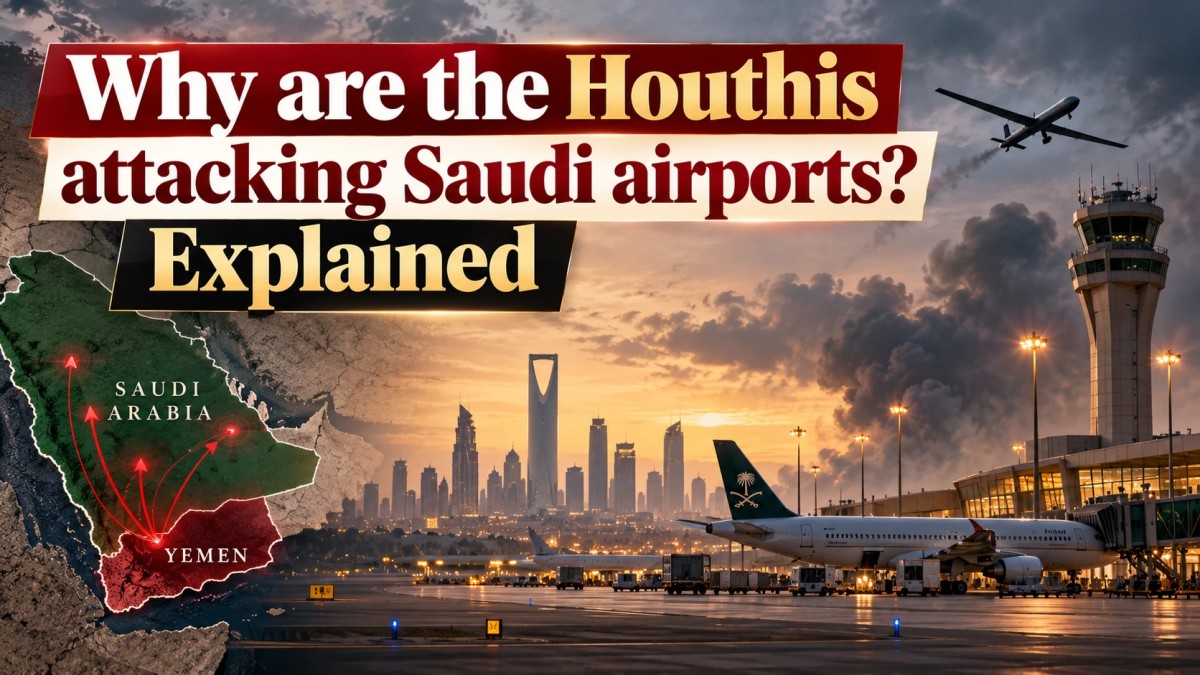
Yemen's Houthi movement has been firing missiles and drones at Saudi airports since early October 2026, killing at least 20 people, including an Indian, and shutting Riyadh's main airport. The short answer to "why" is that a 2022 truce between the two sides collapsed this summer, after a Saudi strike on Yemen's capital, and the Houthis have chosen to hit Saudi Arabia where it hurts most: its airports and its economy.
Here's how the war started, why it restarted, and why it matters for the 2.75 million Indians who live in Saudi Arabia.
Key points
- The Houthis, formally Ansar Allah, control much of northern Yemen, including the capital Sanaa, since 2014.
- A Saudi-led coalition has fought them since 2015; a UN-brokered truce in 2022 largely stopped cross-border attacks.
- After a Saudi strike on Sanaa airport on 13 July 2026, the Houthis declared the truce over and later launched attacks on Saudi airports.
- Strikes on Riyadh's King Khalid International Airport on 10 and 11 October killed at least 13 people; an Indian man from Hyderabad died of his injuries.
- India has condemned the attacks; its airlines have suspended many Saudi flights.
Who are the Houthis?
The Houthis are an armed political movement from north-western Yemen, named after the family of their founder, Hussein Badreddin al-Houthi. They call themselves Ansar Allah, "supporters of God". Their base is among the Zaidis, a branch of Shia Islam found mainly in Yemen.
They started as a religious revival movement in the 1990s and fought six rounds of war with Yemen's government in the 2000s. In September 2014 they seized Sanaa, and the internationally recognised government fled south. Today they control most of Yemen's population, though not most of its territory.
Iran backs them politically and, according to the UN and Western governments, with weapons, which Iran denies supplying in breach of UN rules. The Houthis say they act independently.
How the Saudi–Houthi war began
In March 2015, Saudi Arabia led a coalition of mostly Arab states into Yemen to restore the ousted government and push back the Houthis, whom Riyadh saw as an Iranian foothold on its southern border. What was meant to be a short campaign turned into a long war of air strikes, blockades and ground fighting.
The cost to Yemen has been enormous. A UN Development Programme study estimated that by the end of 2021 the war had caused about 377,000 deaths, directly and through hunger and disease. The UN has repeatedly described Yemen as one of the world's worst humanitarian crises.
The Houthis hit back across the border with missiles and drones, including attacks on Saudi oil facilities and airports in the late 2010s and early 2020s.
In April 2022, a UN-brokered truce largely stopped the fighting and the cross-border strikes. Even after its formal expiry later that year, it broadly held. Saudi Arabia and the Houthis held direct talks.
Why the Houthis are attacking Saudi Arabia now
The truce broke down this year. On 13 July 2026, a Saudi air strike hit Sanaa International Airport, targeting a flight of the Iranian airline Mahan Air. The Houthis then announced the end of the truce, declared a blockade on Saudi Arabia and launched new offensives.
The airport campaign followed. Between 6 and 12 October:
- 6–7 October: missiles and drones hit King Khalid International Airport in Riyadh and Abha airport in the south-west.
- 8 October: two attacks on Riyadh destroyed a Saudia passenger jet on the ground; Saudi officials said three Saudis, including the pilot, were killed.
- 10 October: a ballistic missile struck the complex containing Terminals 3 and 4 at Riyadh, killing 12 in the first count and injuring more than 300.
- 11 October: Terminal 4 was hit again; King Fahd International Airport in Dammam was also attacked.
- 12 October: Saudi Arabia said it intercepted three ballistic missiles.
Houthi official Mohammed al-Bukhaiti claimed the strikes as retaliation for Saudi attacks on civilian infrastructure in Yemen. Military spokesman Yahya Saree warned airlines against using Saudi airports, except those serving Mecca and Madinah.
Saudi Arabia called the 10 October strike a war crime and promised a response. UN Secretary-General António Guterres condemned the attack, and the UN envoy Hans Grundberg called it a grave escalation.
Why airports?
Airports are where Saudi Arabia is most exposed. The kingdom is spending heavily to become a tourism, business and events hub, with new airlines and expanded terminals. Shutting Riyadh's airport, even for a week, hits that plan directly, as well as the millions of foreign workers and pilgrims who depend on it.
There's also a message in the exception. By telling airlines to avoid Saudi airports other than those serving Mecca and Madinah, the Houthis are signalling that they don't want to be seen attacking Muslim pilgrims, while still damaging the Saudi state.
Why it matters: For India, this is a war on the doorstep of its largest diaspora. About 2.75 million Indians live in Saudi Arabia, according to India's Ministry of External Affairs, and hundreds of thousands more travel there each year for work and Umrah. For readers elsewhere, it's a conflict that can lift oil prices, disrupt Gulf air travel and pull in Iran and the United States.
What it means for India
The human impact came first. An Indian IT engineer from Hyderabad on his family's first Umrah died after the 10 October strike, and 11 Indians were among the injured, according to Indian media reports. The Ministry of External Affairs condemned the attacks on 8 and 11 October, calling repeated strikes on civilians unacceptable.
Then there's travel. Air India, IndiGo, Akasa Air and Air India Express have suspended many Saudi routes into the second half of October.
Oil is the wider risk. Brent crude has traded above $100 a barrel, and the Reserve Bank of India cited geopolitical tensions and oil when it raised interest rates on 7 October. India imports most of its crude, much of it from the Gulf.
India has been here before. In April 2015, as the war began, India's Operation Rahat evacuated more than 4,600 Indians, and hundreds of people of other nationalities, from Yemen by sea and air. The Indian Navy has also kept warships in the Arabian Sea and Gulf of Aden to protect shipping, especially after Houthi attacks on Red Sea vessels from late 2023.
What happens next
Iran has offered to mediate, saying further escalation only benefits Israel. US President Donald Trump called the attack unacceptable and said a decision on US action was pending. Saudi Arabia has promised a response.
Riyadh's main airport reopened on 18 October, but Indian airlines kept most Saudi flights suspended until 24 October, The National reported. The key signals to watch are whether Riyadh airport reopens and stays open, whether the Houthis strike again, and whether the UN can restart talks. A return to the 2022 truce would be the best outcome for the region, and for the Indians who live in it.
Wars in Yemen have a way of being forgotten until they reach someone else's doorstep. This time, the doorstep is a Riyadh terminal used every day by Indian workers going home on leave. That alone should keep India paying attention.
Frequently asked questions
What's Your Reaction?
 Like
0
 Dislike
0
 Love
0
 Funny
0
 Wow
0
 Sad
0
 Angry
0




Comments (0)