


 Study in UK
UK Graduate visa cut to 18 months, guide for Indian students
From 1 Jan 2027, the UK Graduate visa drops from 2 years to 18 months for bachelor's and master's graduates. Who's affected, the deadline, and what to do.

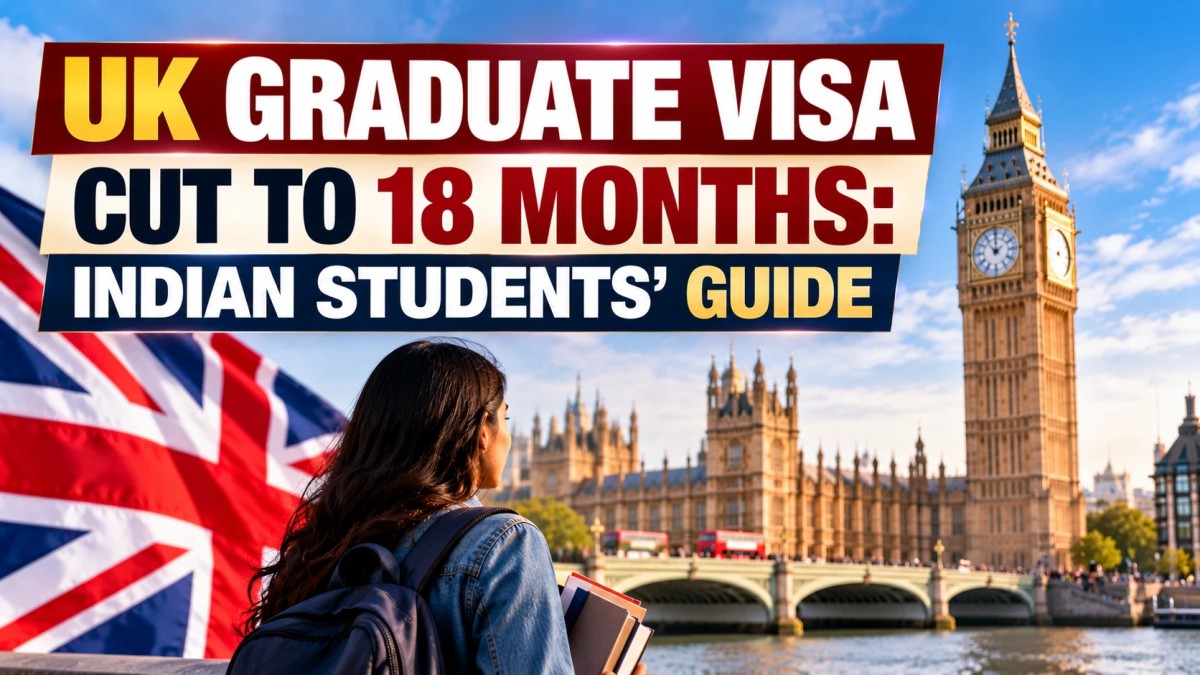
Indian students finishing a UK degree have about ten weeks to secure the full two years of post-study work. From 1 January 2027, the UK's Graduate route, the visa that lets international graduates stay and work after their course, drops from two years to 18 months for bachelor's and master's graduates. PhD graduates keep three years.
What matters is the date you apply, not the date of your graduation ceremony. Applications made on or before 31 December 2026 still get the current two years, if you're eligible to apply by then.
Key points
- Graduate route for bachelor's and master's degrees: 2 years now, 18 months for applications made on or after 1 January 2027.
- PhD graduates: unchanged at 3 years.
- The change was laid before Parliament on 14 October 2025 in a Statement of Changes to the Immigration Rules (HC 1333).
- The UK government expects about 12,000 fewer Graduate route applications a year.
- You must apply from inside the UK, before your Student visa expires, and after your university reports that you've completed your course.
UK Graduate route 18 months: what exactly changes
The Graduate route was introduced in 2021 and quickly became one of the main reasons Indian students picked the UK. It doesn't need a job offer or a sponsor: graduates can work at any level, change jobs freely, or look for work.
The immigration white paper published in May 2025 proposed shortening it. The rule change was then written into a Statement of Changes laid before Parliament on 14 October 2025, the education news site The PIE News reported. It took effect in the rules in November 2025, but only applies to applications made on or after 1 January 2027.
Lord Hanson, the Home Office minister, said the government's data showed "too many graduates are not progressing into graduate-level employment", according to The PIE News. The government's impact assessment expects a "modest impact" on demand, about 12,000 fewer applications a year.
Who is affected, and who isn't
Affected: anyone who applies for the Graduate route on or after 1 January 2027 after a bachelor's or master's degree. That includes most Indian students starting a one-year master's in September 2026 and finishing in late 2027.
Not affected:
- People already on the Graduate route keep the permission they were granted.
- PhD and other doctoral graduates still get three years.
- Anyone who applies on or before 31 December 2026, and is eligible to apply at that point, gets two years.
The 31 December deadline: can you still make it?
Possibly, but it depends on your course calendar. To apply for the Graduate route you generally must:
- be in the UK on a Student visa that hasn't expired;
- have completed your course, with your university having reported that to the Home Office; and
- apply online and pay the visa fee and the Immigration Health Surcharge.
For students on one-year master's degrees that started in September or October 2025, results and completion often come in late 2026, so some will be able to apply before 31 December and some won't. If your dissertation deadline or exam board falls in December, ask your university's international student office now when it will report your completion. Don't graduate in your head before the university does in its records.
If you can't apply before 31 December, you haven't lost the route, only six months of it. Students who finish in early 2027 should still apply as soon as their completion is reported, because the Graduate visa can only be applied for while the Student visa is valid.
Why it matters: India is one of the largest sources of international students in the UK, and Indians have been among the biggest users of the Graduate route. Six fewer months of open work rights means less time to find a job that can sponsor a Skilled Worker visa. For UK universities, already under financial pressure, it's another reason some Indian families may look at Canada, Australia, Ireland or Germany instead.
What else has changed for Indians in the UK
The Graduate route cut is part of a wider package of tighter rules:
- English for skilled workers: from 8 January 2026, Skilled Worker, Scale-up and High Potential Individual applicants need English at B2 level, up from B1.
- Proof of funds: since 11 November 2025, new students must show £1,529 a month for living costs in London and £1,171 a month elsewhere.
- Start-up founders: the Start-up visa closed to new applicants, replaced by the Innovator Founder route from 25 November 2025, with progress checks at 12 and 24 months.
- Costs for employers: the Immigration Skills Charge that sponsors pay rose by 32%.
- High Potential Individual visa: the annual cap was doubled from 4,000 to 8,000.
Proposals to lengthen the wait for permanent settlement (Indefinite Leave to Remain) have also been discussed by the government. Check gov.uk for what's actually in force before planning around any of them.
How the UK now compares
For Indian families choosing where to study, post-study work rights are often the deciding factor. The broad picture, which changes often and must be checked on each government's website:
- United States: OPT gives 12 months of work, plus up to 24 months for STEM graduates, though a large new fee has been proposed.
- Canada: the Post-Graduation Work Permit can last up to three years, depending on the length of the programme, but Canada has also cut study permits and tightened eligibility.
- Australia: the Temporary Graduate visa gives most bachelor's and master's graduates two years, and doctoral graduates three.
- Ireland: master's graduates can stay up to two years under the Third Level Graduate Programme.
- Germany: graduates get up to 18 months to look for a job that matches their degree.
On paper, 18 months puts the UK in the middle of that range rather than near the top. The UK's one-year master's degrees still mean a shorter, cheaper course overall, which is why many Indian families will keep choosing it.
These rules change often, so check each government's official website before you decide.
What Indian students can do now
None of this is legal advice. A few practical steps:
- Students finishing in 2026: check whether you can complete and apply by 31 December. Keep your Student visa valid until you apply.
- Students starting in 2026 or 2027: plan on 18 months. Use your course year to build towards a sponsored job: internships, placements, and employers that hold a sponsor licence.
- Think about the switch: the Skilled Worker visa needs a job from a licensed sponsor that meets skill and salary thresholds. Starting the search during your degree, not after it, matters more with 18 months.
- Watch for fraud: be wary of agents promising "guaranteed" jobs or visas. Visa decisions are made only by UK Visas and Immigration.
Eighteen months is still more than most countries gave international graduates a decade ago. But for a student who took a large education loan in Hyderabad or Pune on the promise of two years to find their feet in London, the six months that just disappeared were part of the calculation, and the calculation now has to be redone.
This article is general information, not legal advice.
Frequently asked questions
What's Your Reaction?
 Like
0
 Dislike
0
 Love
0
 Funny
0
 Wow
0
 Sad
0
 Angry
0




Comments (0)