


Student visas 2026 compared for US, UK, Canada, Australia
US, UK, Canada and Australia all tightened student visas. How the four compare on caps, money, work after study and new fees, for Indian students in 2026.

New Delhi (Desk), 18 Oct 2026 (IST) · Explainer
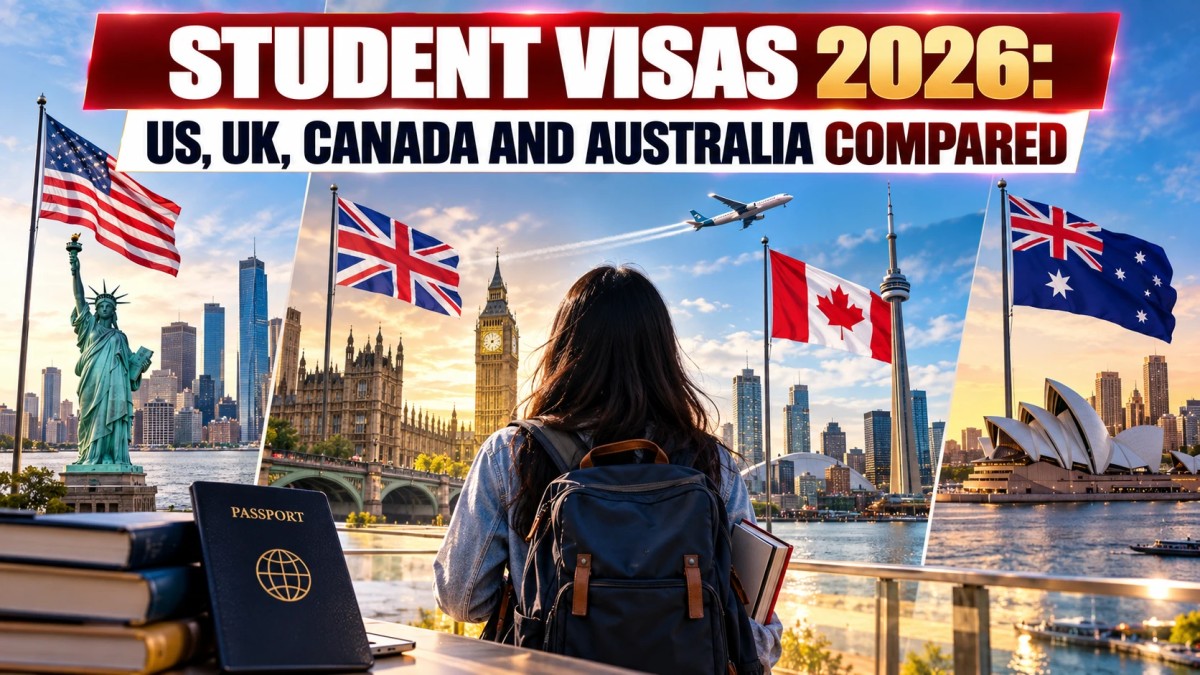
For a generation of Indian students, the US, the UK, Canada and Australia were the obvious places to study abroad. All four have tightened their student visa rules since 2024, through caps, higher fees, larger savings requirements or shorter work rights after graduation.
This guide sets out how the four compare in 2026, so families can plan with the current rules rather than last year's.
Key points
- US: no cap on student visas, but a new $250 visa integrity fee and a contested rule to replace open-ended "duration of status".
- UK: living-cost funds rise to £1,570 a month in London from 30 November 2026; the Graduate visa falls to 18 months from January 2027.
- Canada: up to 408,000 study permits in 2026, including 155,000 for new arrivals.
- Australia: a planning level of 295,000 new international students for 2026 and 2027; visa charges rose 25% on 1 July 2026.
- Rules change often; check each government's site before you apply.
Student visa comparison 2026 at a glance
| US (F-1) | UK (Student) | Canada (study permit) | Australia (subclass 500) | |
|---|---|---|---|---|
| Limit on numbers | No national cap | No cap | Annual cap on permits | Planning level per institution |
| Key 2026 change | $250 integrity fee; duration-of-status rule | Higher funds from 30 Nov 2026 | 408,000 permits planned | 295,000 planning level; fee up 25% |
| Work after study | OPT, 12 months (STEM: up to 36) | Graduate visa: 2 years, 18 months from Jan 2027 | Post-graduation work permit, if eligible | Temporary graduate visa, if eligible |
United States: no cap, more checks
The US doesn't limit the number of F-1 visas. The hurdles are cost and scrutiny. Students pay the visa application fee (reported at $185), the SEVIS fee ($350), and now a $250 visa integrity fee created by a 2025 US law, which can't be waived, according to student advisers.
The bigger change is the plan to end "duration of status", the rule that lets students stay as long as they are enrolled. Reports say a final rule published in July 2026 would give students a fixed period of up to four years, with extensions through USCIS, and a shorter grace period after study. One report says a federal court paused it on 14 September 2026, a day before it was due to start. Families should check its current status with their university's international office.
A separate proposal for a $70,000 fee on some OPT work authorisations, reported in October, is not yet law. We covered it in a separate article.
Work after study: Optional Practical Training (OPT) allows 12 months of work, extendable by 24 months for STEM degrees. Many Indian graduates then try for an H-1B visa.
United Kingdom: more savings, shorter Graduate visa
There is no cap on UK student visas, but the money test is getting stricter. For applications made on or after 30 November 2026, students need living-cost funds of £1,570 a month in London or £1,203 a month elsewhere, for up to nine months, on top of the first year's fees, according to OTS Solicitors' summary of the Home Office change. The date of the application decides which rate applies.
Work after study: The Graduate visa, which lets students stay and work without a sponsor, falls from two years to 18 months for bachelor's and master's graduates applying on or after 1 January 2027. PhD graduates keep three years. Most students on postgraduate taught courses can't bring dependants.
Canada: a cap on permits
Canada has capped study permits since 2024. Immigration, Refugees and Citizenship Canada (IRCC) expects to issue up to 408,000 study permits in 2026: about 155,000 for new students and 253,000 for extensions, according to ApplyBoard and other trackers. Most applicants need a provincial attestation letter (PAL) from the province where they will study. Master's and doctoral students at public institutions no longer need one from 1 January 2026.
Work after study: A post-graduation work permit is available for eligible programmes and fields. Since 2024, eligibility has depended more on the field of study and language test results, so check the list before choosing a course.
Australia: a planning level and higher fees
Australia uses a national planning level rather than a hard cap: 295,000 new international students in 2026, held at the same level for 2027, according to the International Education Association of Australia. Visa processing is fastest for institutions still below their allocation, so a university's quota can affect how quickly your visa is processed.
Student and graduate visa charges rose by 25% on 1 July 2026. Check the current amount on the Department of Home Affairs website.
Work after study: The temporary graduate visa offers work rights after study, with the length depending on the qualification and age limits.
Why it matters: India sends more students abroad than almost any other country, and Indian families often spend a large share of their savings, or take loans, to fund a degree overseas. Tighter rules change the return on that investment, especially the length of work rights after graduation, which many students rely on to repay loans. Choosing a destination now means comparing the whole path, from visa to first job, not just university rankings.
Choosing a country: questions to ask
- How long can I work after graduating, and in what jobs?
- How much must I show in savings, and in what form?
- Is my course and university eligible for post-study work?
- Can my spouse come, and can they work?
- What are the total fees, including visa and health charges?
Costs to budget for beyond tuition
Tuition is the biggest cost, but families often underestimate the rest. Before choosing a country, add up:
- Visa fees and charges, including the US integrity fee and SEVIS fee, or the Australian visa charge after its July 2026 rise.
- Health cover: the UK's Immigration Health Surcharge, compulsory health insurance in Australia (Overseas Student Health Cover) and university health plans in the US.
- Proof of funds: the money you must show in a bank account, often for a fixed period before applying, in the form each country accepts.
- Language tests such as IELTS, TOEFL or PTE, and sometimes a second attempt.
- Travel and housing deposits, which are often due before the visa is granted.
A timeline for the September 2027 intake
- Now to December 2026: shortlist courses, check each country's latest rules and take language tests.
- January to March 2027: apply to universities; many deadlines fall here.
- April to June 2027: accept an offer, pay deposits, arrange funds and apply for the visa as early as the rules allow.
- July to August 2027: book travel and housing once the visa is in hand.
Studying abroad is still possible and still valuable. But the rules now change from one intake to the next, so the most useful thing a family can do is check the official sites in the month they apply, not the year before.
This article is general information, not legal or immigration advice.
Frequently asked questions
What's Your Reaction?
 Like
0
 Dislike
0
 Love
0
 Funny
0
 Wow
0
 Sad
0
 Angry
0




Comments (0)